
Educational Guide
How to teach a child to tell time? The 5-step Montessori method
Learning to tell time is a pivotal milestone in a child's life. It is the moment they begin to understand the structure of their day, anticipate events, and, above all, gain independence. However, the concept of time is abstract and complex. In the Montessori approach, we address this notion in a concrete and sensory way to turn this challenge into a rewarding experience.
At what age should you teach time?
There is no "perfect" age, but most children show an interest around 5 or 6 years old. Before tackling reading the hands of a clock, the child must master certain basics: knowing how to count to 60 and understanding the concept of cycles. Furthermore, if your child is just beginning their exploration of numbers, do not hesitate to consult our advice on helping your child learn to count.
The Montessori method in 5 concrete steps
Step 1: Visualize the passage of time
Time is invisible. To help them, use hourglasses or visual timers. The child must "see" the minutes ticking away. In a well-designed Montessori bedroom, as we explored in our layout guide, every object has its place to foster this understanding of the world.
Use color coding. Red for hours, blue for minutes. This immediate visual distinction prevents many confusions during the first attempts.
Step 2: Use a movable clock
The child must be able to touch the hands. Use a teaching clock where the hands are geared (moving the minute hand moves the hour hand). This is the principle of the hand instructing the mind.
Step 3: Introduce the full hours
Always start with the o'clock hours. "It is 3 o'clock: the short hand is on the 3, the long hand is at the very top." Associate these moments with rituals: snack time, nap time, bath time.
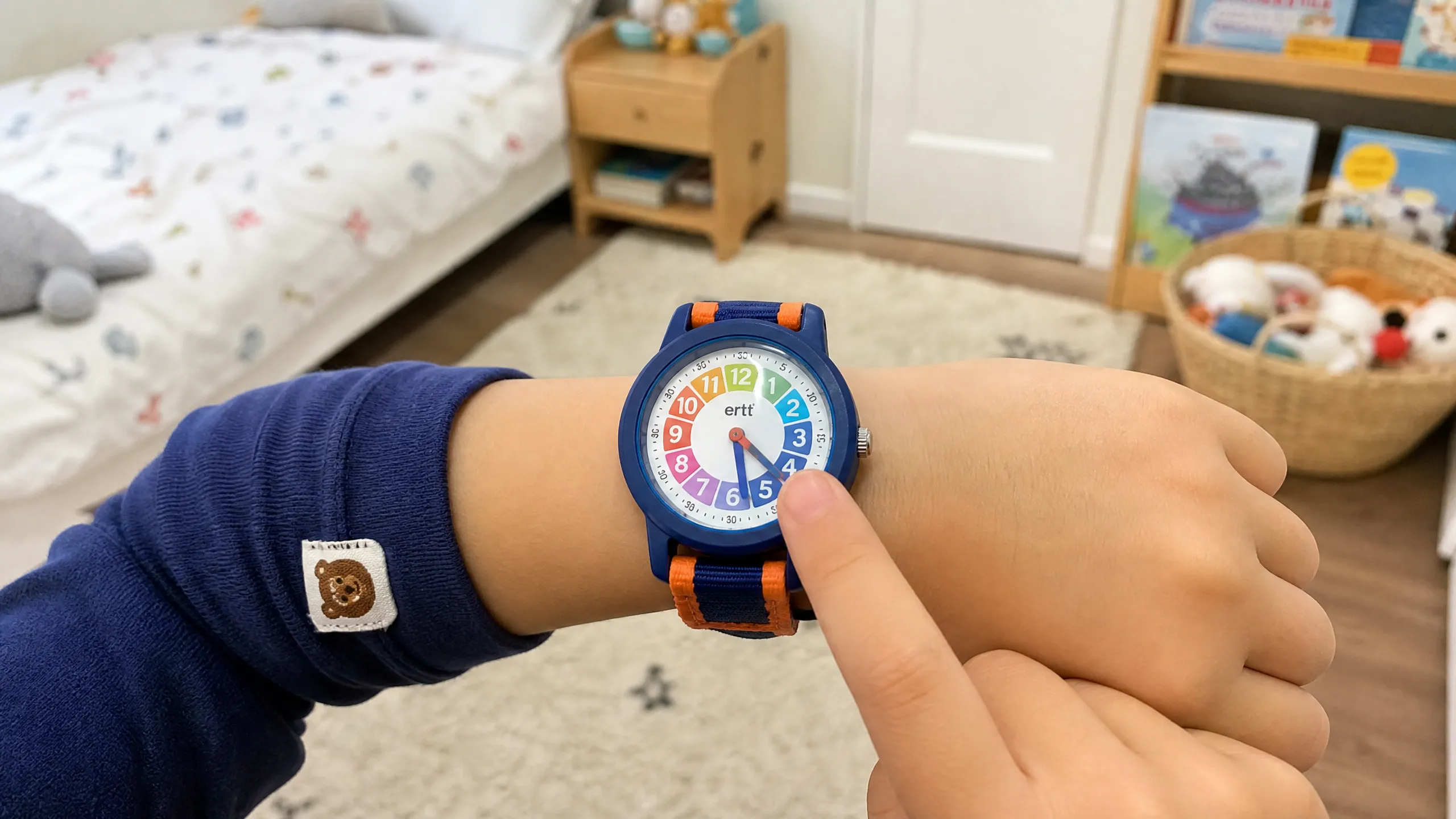
To support this learning in daily life, nothing replaces a tool adapted to the child's wrist.
Discover our Montessori watches for learning to tell time →Step 4: Understand minutes in increments of 5
Once hours are mastered, introduce minutes. Explain that each number also represents a "jump" of 5 minutes. This is where knowing how to count by 5s becomes a real superpower for the child.
Step 5: Using a personal watch
This is the final step toward autonomy. Having their own watch allows the child to take ownership of time. They no longer ask "when is it?", they check for themselves.
Frequently Asked Questions (FAQ)
Choose a watch with a clear dial, easy-to-read numbers, and, if possible, color-coding to distinguish between hours and minutes. Our colored learning watch is specially designed for this.
Each child progresses at their own pace. It can take a few weeks or several months. The important thing is to keep it playful and avoid any pressure.
Pour passer à la pratique
Les jouets qui vont avec cet article
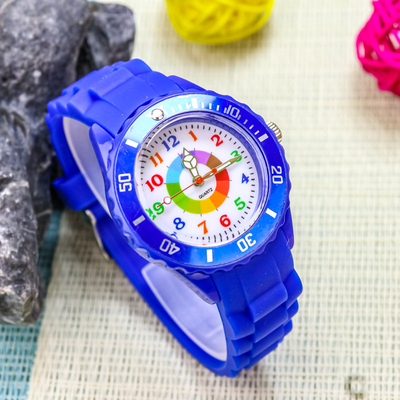 Montessori educational watch for children - Learn the time in color 24,90 €
  Cartoon Style Silicone Educational Watch 24,90 €
 Livraison offerte dès 50 € · Retour 20 jours