
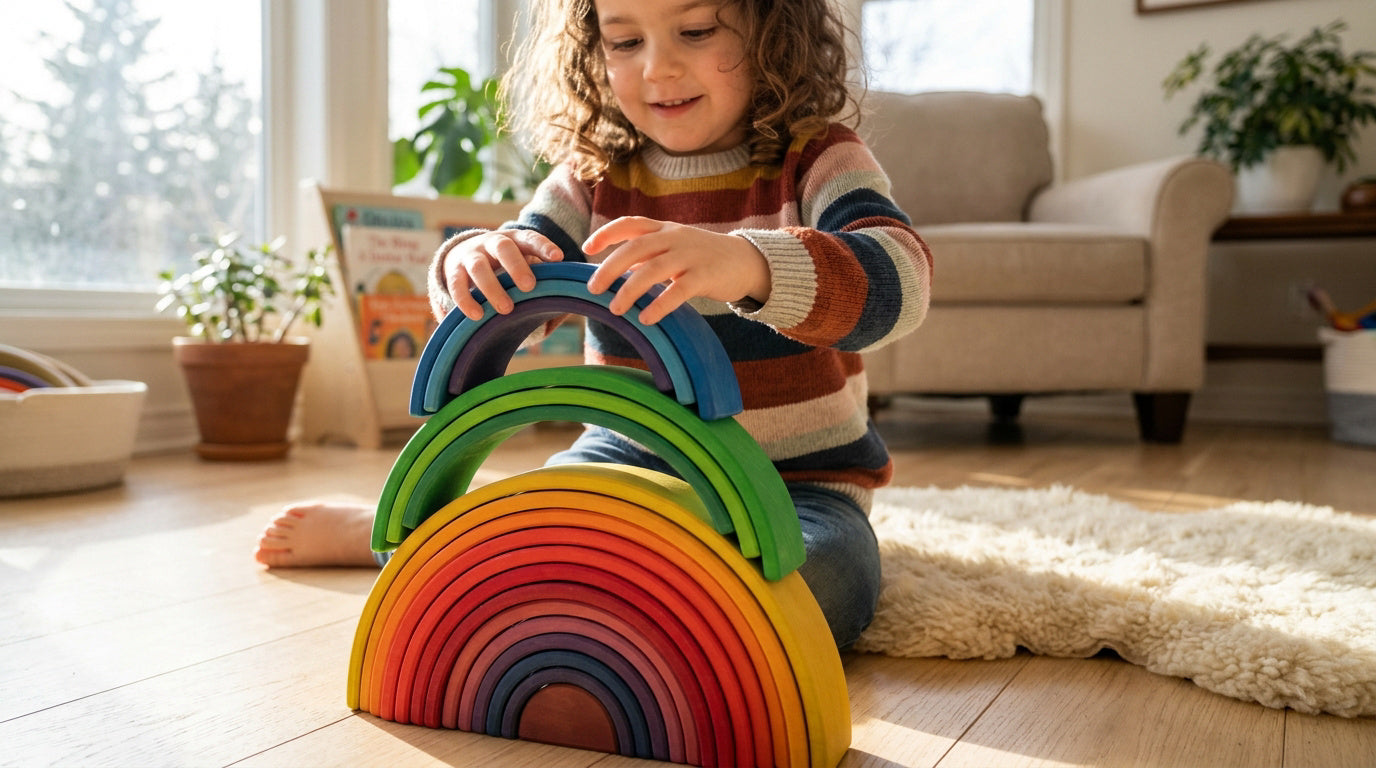

The Montessori wooden rainbow has become a staple in children's bedrooms, offering a unique sensory approach to stimulate fine motor skills starting at 12 months. This versatile educational aid turns every manipulation session into a concrete lesson in physics and spatial geometry.
However, this material is often perceived as a simple decorative object, thus limiting its immense educational potential. We will help you leverage all its facets to lastingly transform your child's daily development.
- Why the Montessori wooden rainbow supports sensory development
- 3 game scenarios to stimulate the imagination
- Wooden Montessori beehive: simplified color learning
- Montessori DIY construction game: boosting psychomotricity
- Montessori balance game: unleashing spatial creativity
- Wooden Montessori magnetic tangram: mastering shapes
- Montessori busy board: stimulating development through movement
- How to choose and maintain your wooden material?
Why the Montessori wooden rainbow supports sensory development
The Montessori wooden rainbow stimulates fine motor skills from 12 months thanks to its ergonomic arches. This versatile toy teaches physics through balance and promotes the learning of primary colors through direct manipulation.
Precision of movement begins with this tactile interaction with raw material.
Developing fine motor skills and coordination through movement
Grasping these arches forces your child to adjust their grip strength. The hand adapts to the unique curvature of each piece. It is a constant physical challenge for their fingers.
The precision required to stack without the pieces falling demands total concentration. The eye guides the hand, promoting the Montessori Busy Board and the development of precise movement.
The texture of the natural wood provides perfect grip. This facilitates the success of the first gripping exercises. Your little ones thus gain confidence daily.
How to use the Montessori wooden rainbow daily? By linking manipulation to colors.
Mastering chromatic nuances and spatial volumes
The colored arches offer a rich visual spectrum. The child names red or yellow while playing. They thus distinguish nuances with real clarity.

Nesting teaches spatial geometry. Each piece finds its place according to its relative size. This is a concrete introduction to scales of size.
- Color identification
- Sorting by size
- Notions of size
3 game scenarios to stimulate the imagination
Beyond the sensory aspect, this material becomes the engine of invented stories where each arch changes function according to your desires.
Transforming arches into tunnels and urban circuits
The curves create passages for your miniature cars. Align the pieces to form a long dark tunnel. Figurines then cross these colored bridges. The game takes on an architectural dimension immediately.

Use verticality to build multi-story garages. This Dinosaur Truck for Kids illustrates the interaction between your toys well.

The arches become animal shelters. The imagination transforms the wood into a city.
Defying gravity with daring balance structures
Flip the arches to test their stability. The child discovers balancing and the breaking point. Each attempt reinforces their understanding of gravity.
Balancing wooden arches teaches perseverance: every fall is a lesson in applied physics that invites one to try again more gently.
Concentration becomes total during assembly. Silence naturally settles into the room.
Wooden Montessori beehive: simplified color learning
If the rainbow works on volumes, other tools specifically target chromatic recognition through precise association.
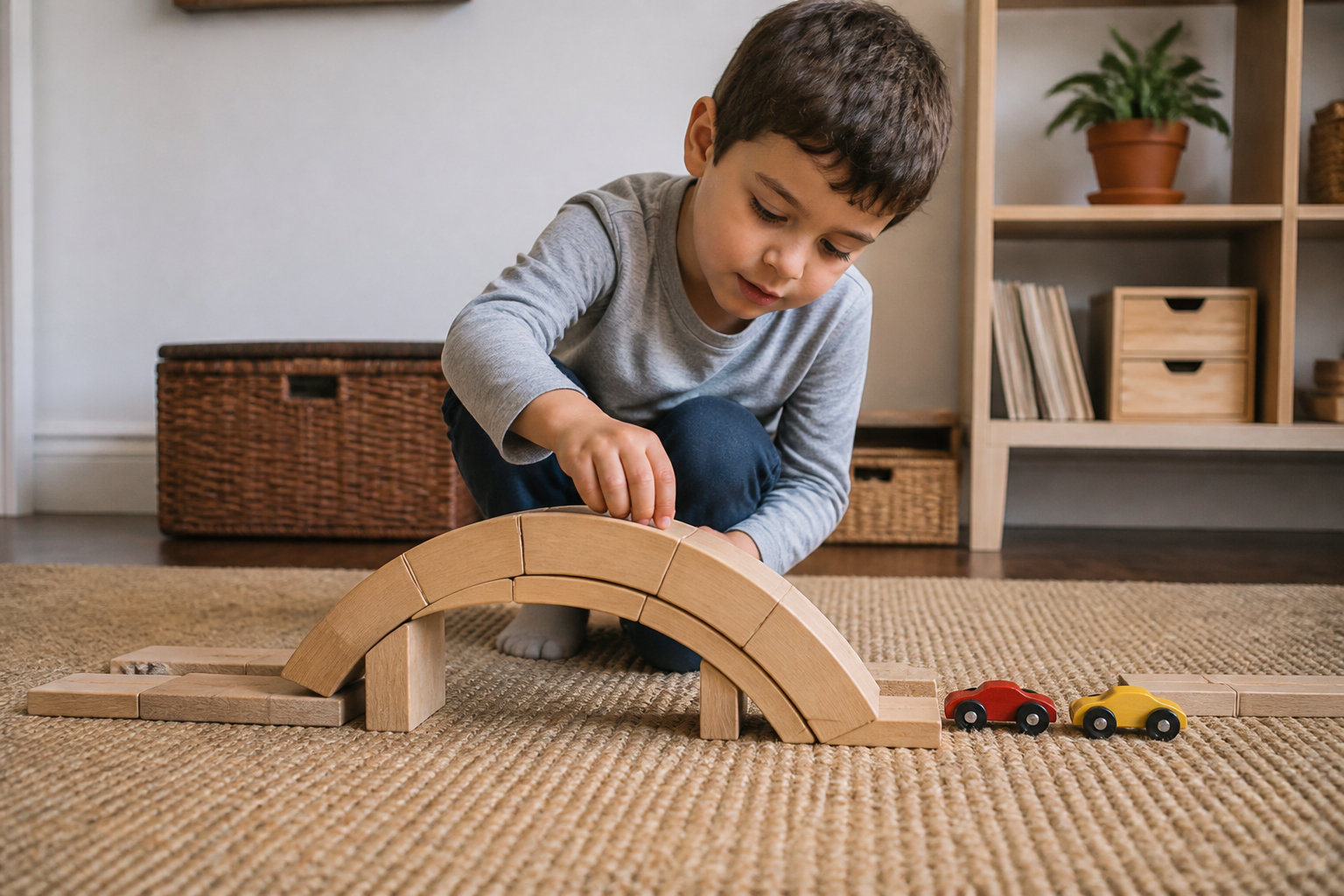
This fun material presents a beehive accompanied by colored bees. Your child uses ergonomic tweezers to place each insect into its corresponding cell. It is a rigorous chromatic sorting exercise.

Compare this approach with the Wooden Montessori Magnetic Tangram to vary the activities. Both methods target visual discrimination. They reinforce autonomy sustainably.
Repeating the precise movement anchors the memorization of shades. The immediate pleasure of success motivates your little learner.
Montessori DIY construction game: boosting psychomotricity
Development also happens through technical assembly, where the hand must screw, tighten, and build solidly.

Using adapted tools allows your children to handle concrete pieces safely. Screwing and assembling these elements develops specific muscle strength in the fingers. To support this progression, the Montessori DIY Construction Game is an ideal learning support.

| Skill | Concrete benefit |
|---|---|
| Coordination | Wrist precision |
| Strength | Finger muscles |
| Logic | Sequence planning |
| Patience | Attention span |
Your child gains autonomy by creating their own objects. They finally feel capable of transforming their immediate environment.
Montessori balance game: unleashing spatial creativity
After pure technique, let's return to the poetry of shapes that stand up as if by magic.
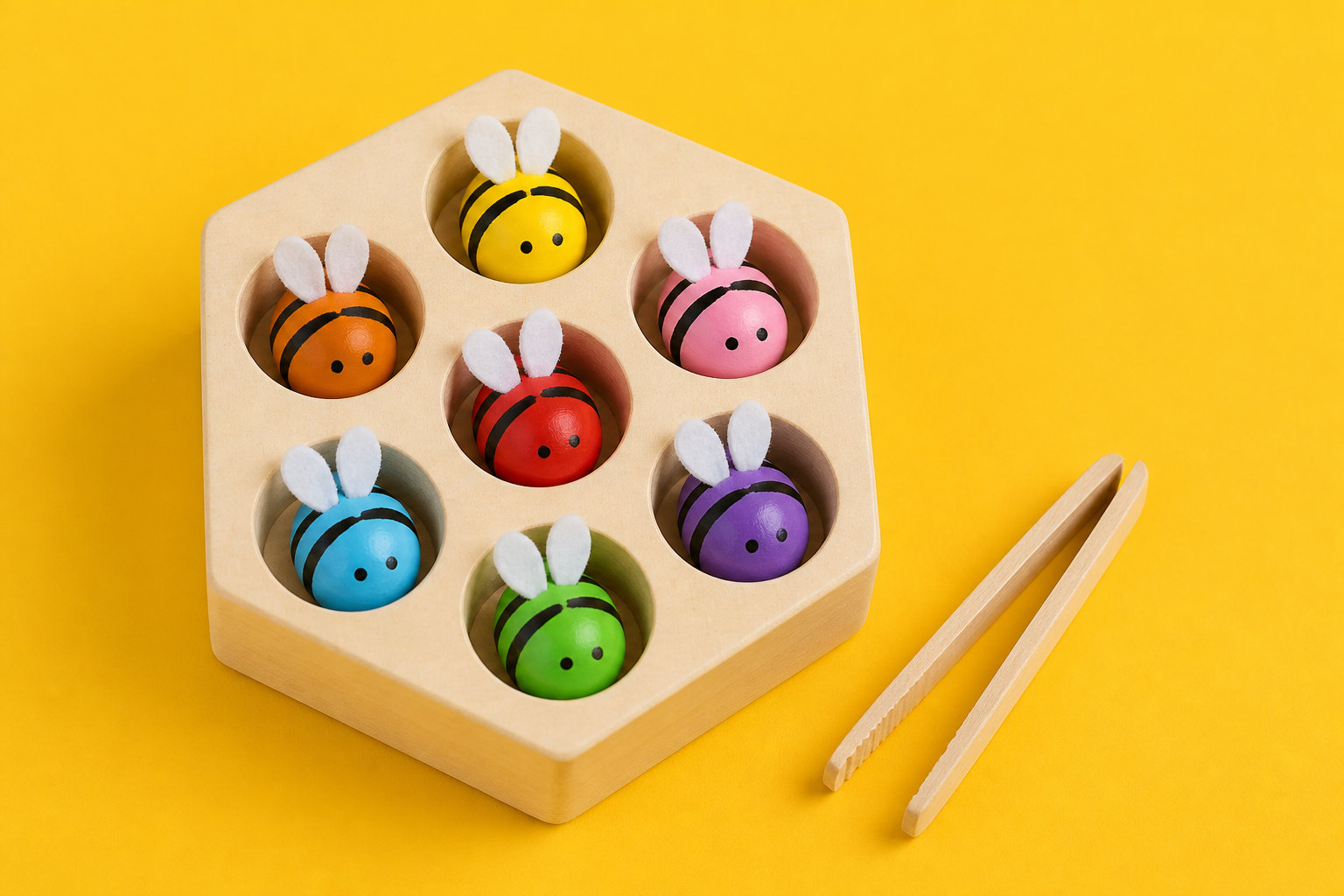
Explore the infinite possibilities of balance blocks. Each stacking becomes a unique ephemeral sculpture. You can also discover our Montessori Balance Game to initiate these workshops.

The child manipulates the volumes to defy gravity. They thus learn to visualize objects in space. How to use the Montessori wooden rainbow daily? By simply integrating it into these construction challenges.
Spatial creativity is born from the freedom to test the limits of an object without fear of failure.
Wood offers a reassuring tactile resistance. It is a noble material for budding architects.
Montessori Magnetic Wooden Tangram: Mastering Shapes
Geometry becomes child's play when shapes magnetically attract each other to create silhouettes.

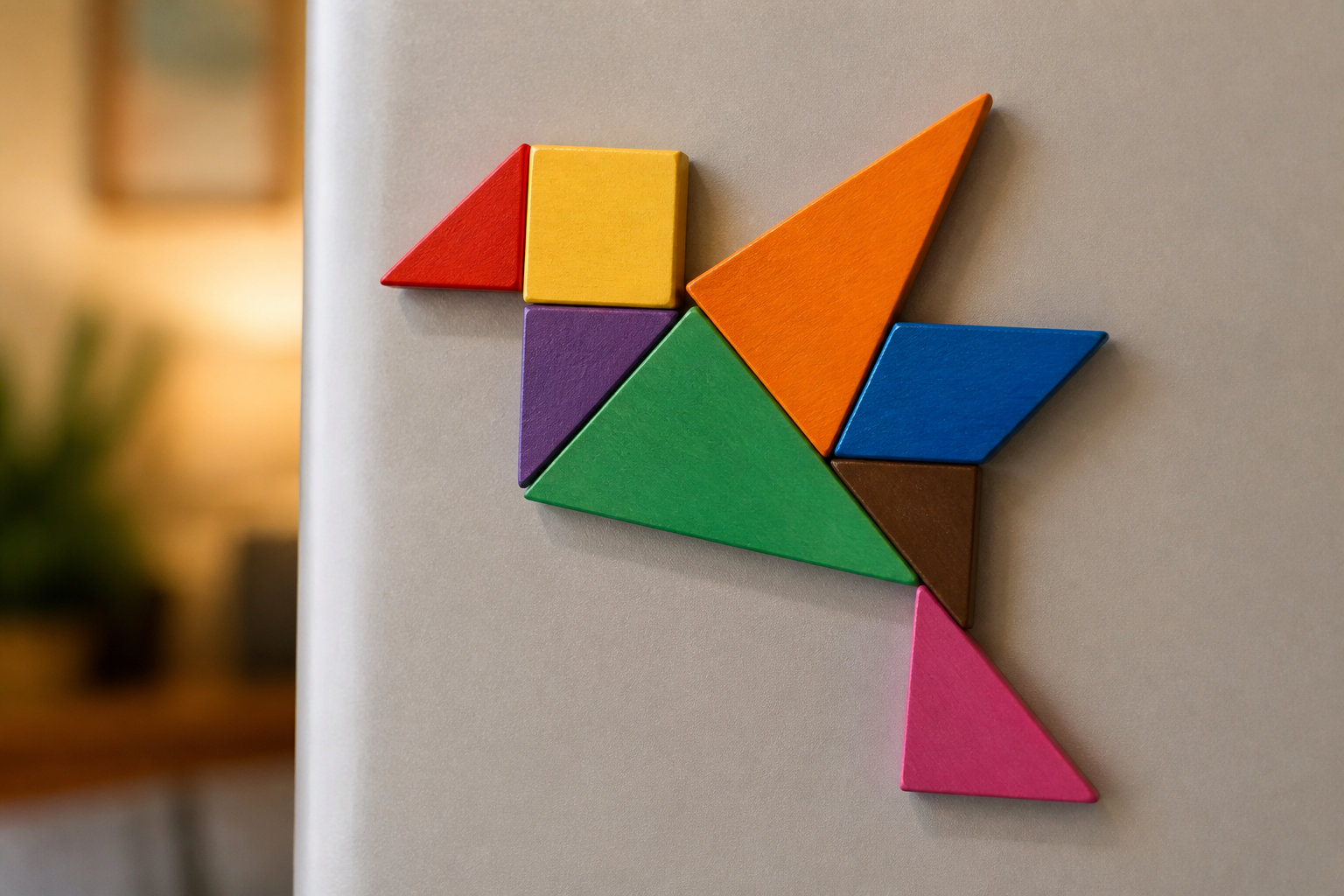
This educational material presents seven classic pieces that allow you to break down complex images into simple geometric units. Your child manipulates triangles and squares with ease thanks to the magnetism that ensures precise placement.

To fully explore this tool, you will find:
- Triangles of various sizes
- Central square
- Parallelogram
- Silhouette templates
This puzzle effectively stimulates spatial vision. It thus prepares your little ones for future abstract mathematical concepts.
Montessori Busy Board: Stimulating Development Through Movement
To perfect this development, the activity board brings together all the challenges of daily life in one place.

Watch your children manipulate latches, buttons, and zippers with total concentration. Each mechanism engages a specific muscle in their hand. They thus practice freely, without any pressure regarding the end result.

After such an intense play session, a Rabbit Night Light promotes immediate soothing. This contrast between cognitive effort and calm is essential. You thus offer a perfect balance to their day.
Curiosity remains the primary driver of this educational support. Your little ones discover the world concretely through touch.
How to Choose and Maintain Your Wooden Material?
Owning beautiful educational items requires some precautions to ensure their longevity and your children's safety.
Check for splinters. Avoid detergents and never soak wood in water. Ensure the non-toxic certification of paints.
Selecting the Right Size According to Your Child's Age
Check the diameter of small parts. For those under three, prioritize large arches. This prevents any risk of accidental ingestion.
Check the paint certification. They must be water-based and solvent-free. Your little one's health relies on healthy materials.
Adapt the weight of the toy. Wood that is too heavy needlessly tires the joints.
Cleaning and Protecting Natural Wood Without Chemicals
Use a slightly damp soft cloth. Wood dislikes excess water, which makes the fibers swell. Immediate air drying is imperative.
Rub stubborn stains with a little neutral soap. Rinse quickly so as not to leave a lasting impact on the material.
Store the arches away from direct sunlight. Intense light could fade the natural pigments.
Regular dusting with a dry cloth is enough to maintain the beauty of the wood. You will then know how to use the Montessori wooden rainbow daily with peace of mind.
The Montessori wooden rainbow transforms development into a unique sensory adventure, stimulating your child's fine motor skills and spatial logic. Manipulate these arches today to build infinite worlds and anchor lasting geometric concepts. Offer this treasure of creativity now to lastingly brighten their learning.
FAQ
From what age can you offer the Montessori rainbow to your child?
This educational material is particularly suitable from 12 months on. At this age, the ergonomic arches allow for easy grasping, helping your little one adjust their strength and refine their hand-eye coordination in complete safety.
For children under three, we recommend prioritizing large-sized models. This ensures easy handling while eliminating any risk of accidental ingestion of the smallest pieces.
How does this wooden toy promote sensory and cognitive development daily?
The wooden rainbow is a versatile tool that stimulates spatial logic and volume recognition. By stacking the arches, your child explores the concepts of balance, symmetry, and scale in a completely intuitive way.
It is also an ideal aid for learning primary colors. Through direct manipulation and sorting, your child visually anchors chromatic nuances, developing their concentration and ability to solve complex problems through play.
What playful activities can you set up to stimulate imagination?
Thanks to its open and non-directive design, this toy transforms according to your child's desires. The arches become tunnels for urban circuits, bridges for figurines, or even shelters for animals, turning the bedroom into a living city.
You can also invite your child to defy gravity by creating daring balance structures. Each fall then becomes a lesson in applied physics, encouraging perseverance and gentle handling in a serene and supportive environment.
What precautions should be taken to maintain your wooden material for the long term?
To preserve the nobility of natural wood, regular dusting with a dry cloth is recommended. In case of a stain, use a slightly damp cloth and dry immediately to prevent fibers from swelling or colors from fading.
We strongly recommend avoiding aggressive detergents or prolonged exposure to direct sunlight. Careful maintenance ensures this educational support will last for generations, retaining all its robustness and original luster.
How to ensure the safety and quality of the arches when purchasing?
Your child's safety is our absolute priority. Always check that the wood has smooth finishes, without splinters or sharp edges, and that the construction is sturdy enough to withstand intensive daily use.
Also ensure that the paints used are water-based, non-toxic, and comply with current safety standards. A healthy material certified as solvent-free is essential to offer a perfectly secure learning environment.
Pour passer à la pratique
Les jouets qui vont avec cet article
 Arbre Cascade en Bois Arc-en-Ciel 39,90 €
  Wooden Tetris Puzzle 27,90 €
  Montessori 3-in-1 Sorting Box, Shapes and Colors 29,90 €
 Livraison offerte dès 50 € · Retour 20 jours