
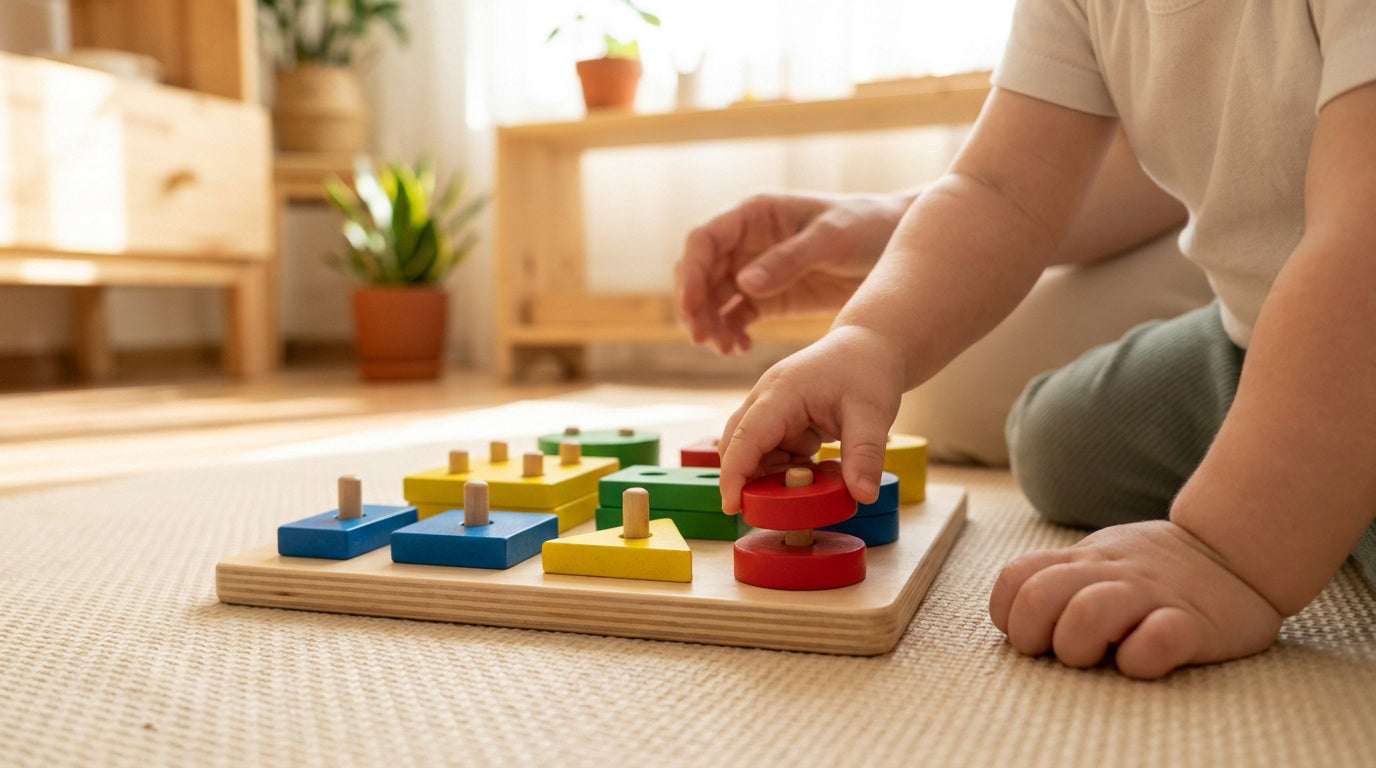

Repeated manipulation of natural wood objects helps refine the precision of movement from 18 months on, thereby consolidating the foundations of gripping. Your child develops rigorous hand-eye coordination by exploring each texture and volume with a Montessori sorting game adapted to their stage of development.
However, poorly adjusted material or an activity that is too complex often ends up discouraging the young explorer instead of stimulating their curiosity. Here, we break down the selection criteria and pedagogical methods to transform these sorting sessions into true levers for autonomy and mathematical logic.
- Why a Montessori sorting game transforms your child's awakening
- Montessori Wooden Bead Kit for sorting and threading
- Montessori Wooden Beehive for color discrimination
- Montessori Magnetic Tangram for geometric exploration
- Montessori Busy Board for mastering daily gestures
- DIY Construction Set for spatial ingenuity
- Montessori Car Track for dynamic coordination
Why a Montessori sorting game transforms your child's awakening
Montessori sorting develops fine motor skills and logic from 18 months using natural wood. Self-correction fosters autonomy, preparing the hand for writing through the precise manipulation of tongs and beads.
Development of fine motor skills and hand-eye coordination
Grasping small objects engages finger muscles. This repeated action refines the precision of daily gestures. It is the foundation for stimulating your child's fine motor skills.
Sorting requires perfect synchronization between sight and movement. The child adjusts their movement to aim correctly. This coordination is vital for future learning.
Manipulating these pieces also prepares the hand to hold a pen. Muscular strength is established for the long term.
Autonomy and self-correction at the heart of learning
Montessori material features built-in error control. The child sees immediately if a piece does not fit. This autonomy reinforces their self-confidence without needing your constant validation.
Your role is that of a discreet observer. Do not correct their errors; let them find the solution on their own. Succeeding without outside help provides immense and lasting satisfaction.
The child naturally perseveres because they feel capable. This sense of competence fosters deep concentration and an authentic love of learning.
Montessori Wooden Bead Kit for sorting and threading
After understanding the foundations of the method, let's see how specific material like wooden beads puts these principles into practice.
Learning shapes through precise threading
Passing a string through a bead requires intense concentration. The child must stabilize both hands simultaneously. It is a formidable but rewarding patience exercise for little ones.
The kit offers various volumes like cubes or spheres. By touching them, the child integrates geometric concepts. Learning colors and shapes with a Montessori sorting game then becomes a concrete tactile experience.
To anchor vocabulary, follow this cycle: 1. Name the object ("This is a cube"), 2. Have them recognize it ("Show me the cube"), 3. Have them name it ("What is this?").
Color discrimination and visual classification
Sorting by color helps organize logical thinking. The child groups elements according to precise visual criteria. Natural wood offers a warm and very reassuring sensory feedback.
Start with two colors, then increase the difficulty. This progression respects the natural rhythm of development.
Color sorting is the first step toward complex mathematical classification.
Montessori Wooden Beehive for color discrimination
If beads work on threading, the beehive game focuses on a more technical tool: wooden tongs.
Using tongs for digital precision
Using tongs requires strengthening the thumb-index opposition. This is a crucial step for holding a pencil. The child learns to gauge their strength so as not to drop the bee.
The wood ensures a firm and lasting grip. This noble material withstands the repeated handling by the youngest ones. Safety is guaranteed by smooth and careful finishes.
Color matching and storage logic
Each bee must find its cell of the same color. This visual matching game facilitates the memorization of chromatic vocabulary. It is a fun activity that captures attention.
You can supplement this exercise with household items. Sort socks or fruit by hue. Learning colors and shapes with a Montessori sorting game then becomes a daily ritual.
- Sorting colored buttons
- Classifying clothespins
- Grouping building blocks by shade
Montessori Magnetic Tangram for geometric exploration
To go further into abstraction, the magnetic tangram introduces building figures in space.
Magnetic geometry and spatial creativity
The magnetic surface prevents the pieces from sliding. This allows the child to focus on their creation. They assemble simple shapes to create complex patterns.
This activity develops spatial vision and imagination. The child understands how shapes fit together. You can find this material here: https://royaumemontessori.fr/products/tangram-magnetique-montessori.
Shape vocabulary and early logic
Name the triangles and squares during the game. Use the three-period lesson to fix the words. The child thus associates the precise term with the touched shape.
The puzzle is self-correcting because the pieces must fit a specific frame. If the pattern goes over, the child adjusts their strategy. It is an excellent lesson in pure logic.
Montessori Busy Board for mastering daily gestures
Beyond shapes, autonomy comes through mastery of everyday objects, which the busy board offers perfectly.
Tactile challenges for practical independence
The board brings together zippers, buttons, and latches. These mechanisms mimic the real challenges of getting dressed in the morning. By practicing on the board, the child gains independence. They learn to manipulate varied textures with great interest.
You can discover the Montessori Busy Board for development to calmly accompany your child.
Check regularly that the elements remain firmly attached. Simple cleaning with a damp cloth preserves the durability of the natural wood.
Sensory awakening and perseverance through movement
Natural curiosity drives the child to explore every nook and cranny. Some mechanisms require patience and several attempts. It is an excellent way to cultivate perseverance in the face of obstacles.
The material is designed to be handled safely. The edges are rounded and the elements firmly fixed. Safety remains the absolute priority for these exploring hands.
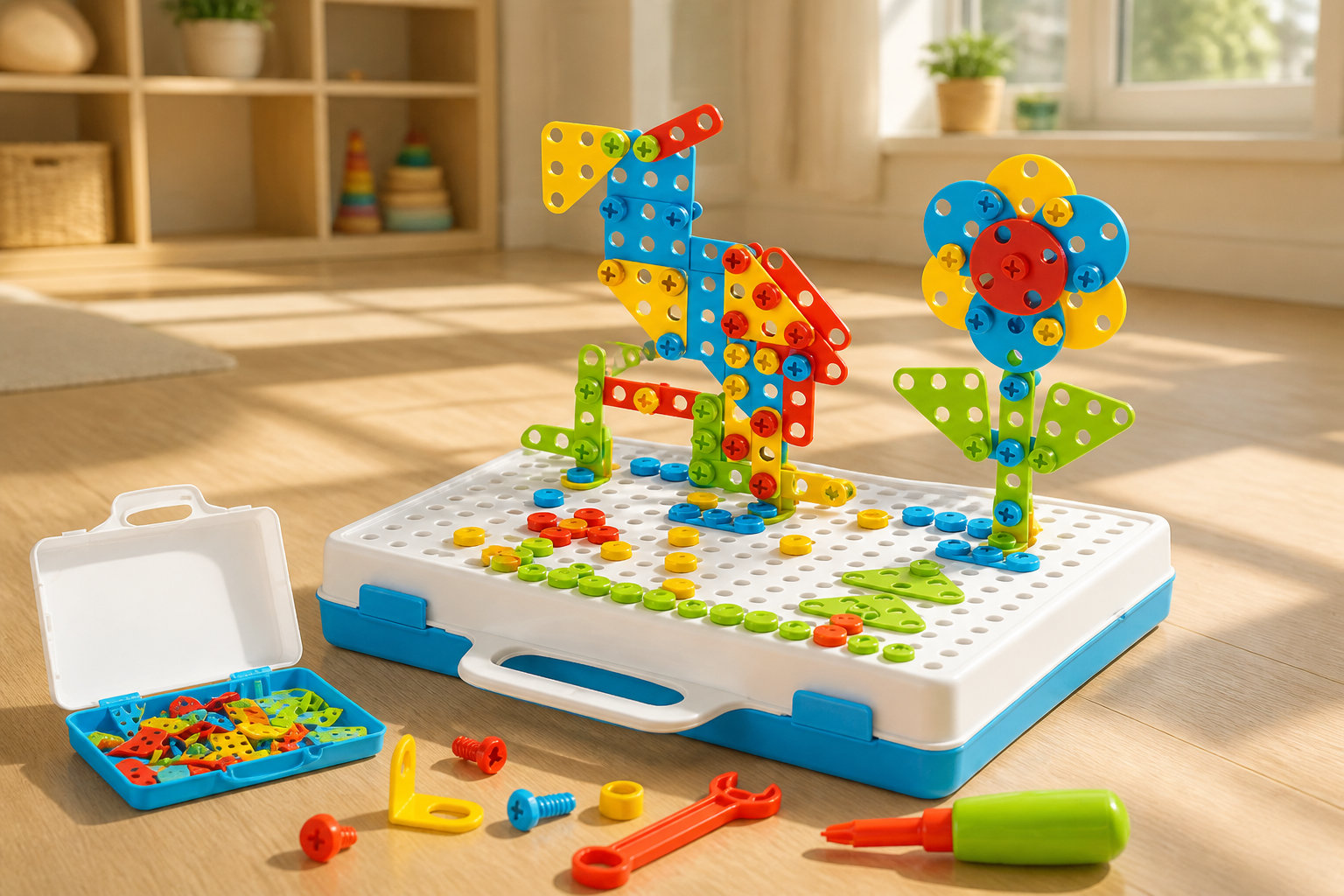
DIY Construction Set for spatial ingenuity
For little engineers, moving on to three-dimensional construction offers a new field for sorting and assembly.
Free assembly and gross motor skills
Screwing and unscrewing develops wrist rotation. This manual strength is useful in many movements of life. The child creates freely according to their own imaginary plans.
The case allows for putting each piece away after the activity. Learning to organize one's material is an integral part of the pedagogy. Discover this support at https://royaumemontessori.fr/products/jeu-de-construction-bricolage-montessori.
Material safety and kit robustness
The components are made with non-toxic materials. The robustness of the kit allows for intensive use from the age of 3. It is a lasting investment for the bedroom.
Seeing a finished object brings great pride to the child. It values their work and sustained effort.
Construction is the language by which the child expresses their understanding of the physical world.
Montessori Car Track for Dynamic Coordination
Finally, the dynamic movement of a car track complements development by working on rapid visual tracking.
Visual tracking and anticipation of movement
Watching the cars descend stimulates visual acuity. The child must anticipate the transition from one level to the next. They gain a concrete understanding of the laws of gravity and cause and effect.
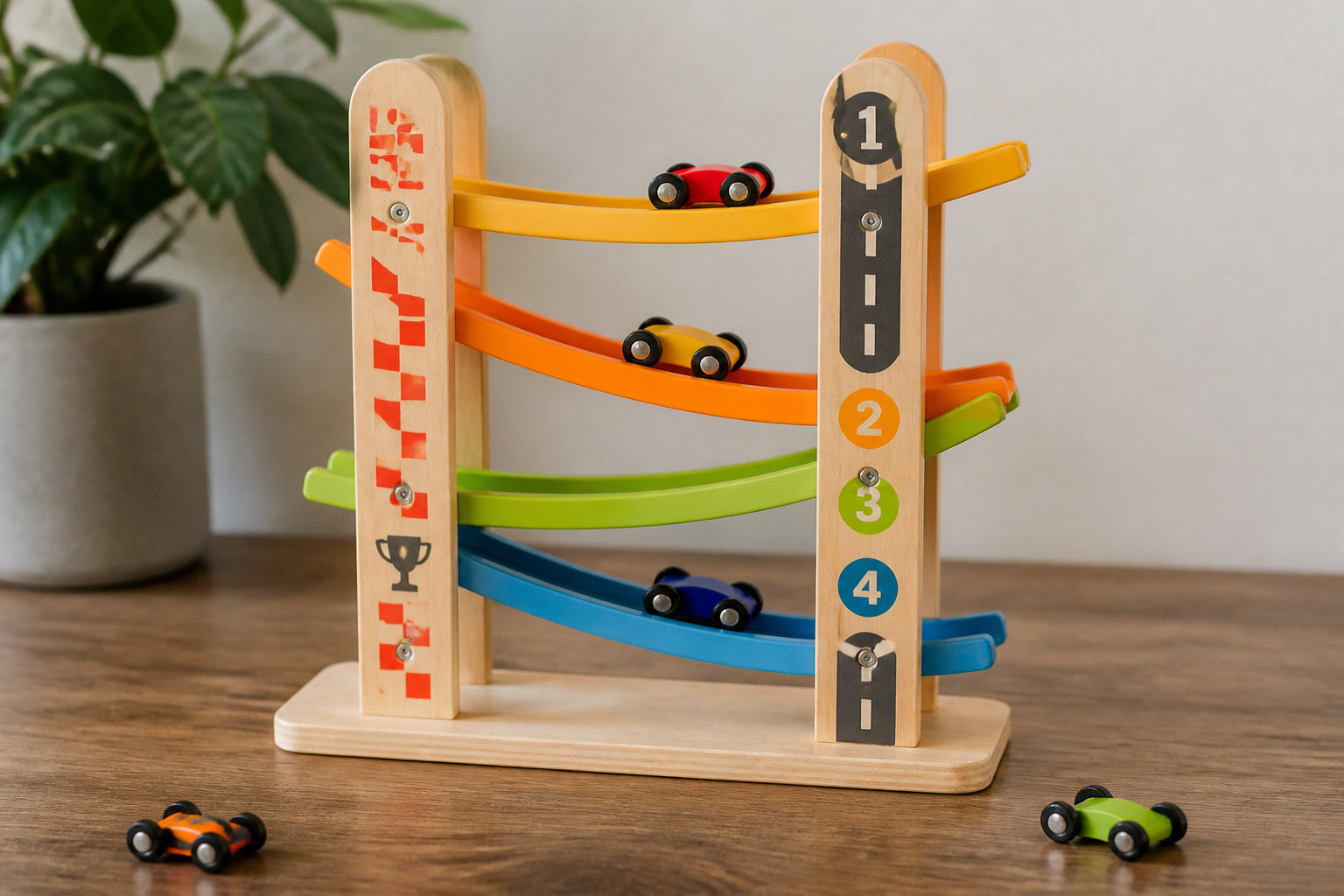
Placing the vehicle on the ramp requires calm precision. It is a highly dynamic hand-eye coordination exercise. The child repeats the gesture tirelessly to observe the result.
Increasing difficulty and perseverance
Vary the fun by timing the descents. This maintains interest and fosters deep, calm concentration.
| Game | Key Skill | Ideal Age |
|---|---|---|
| Beads | Fine motor skills | 18 months + |
| Beehive | Precision | 2 years + |
| Tangram | Logic | 3 years + |
| Track | Visual tracking | 12 months + |
Learning colors and shapes with a Montessori sorting game then becomes a complete sensory experience. You thus support their cognitive development with formidable effectiveness.
By manipulating this Montessori sorting game, your child refines their motor skills, structures their logical thinking, and gains independence through self-correction. Offer them these noble wooden tools now to transform their sensory development into a lasting success. Cultivate their natural genius to forge their future confidence.
FAQ
When is the right time to introduce my child to Montessori sorting games?
The introduction of sorting activities is ideally suited between 18 and 24 months. At this stage of their development, your child begins to demonstrate the ability to fit shapes together and distinguish simple chromatic nuances, marking the beginning of their logical awakening.
We recommend closely observing their interest: if your toddler spontaneously attempts to group objects together, it is a signal that they are ready to manipulate structured materials to refine their visual discrimination.
What are the concrete benefits of sorting shapes and colors for development?
These exercises constitute a fundamental basis for logical reasoning and spatial analysis. By classifying elements according to specific criteria, your child structures their thinking and develops deep concentration, which is essential for future academic learning.
On a motor level, manipulating beads or wooden pieces exercises the pincer grasp. This engagement of fine motor skills and hand-eye coordination directly prepares the hand for later mastery of writing.
How can I ensure the safety and longevity of the sorting materials?
To ensure optimal durability, always favor noble and robust materials like natural wood. This choice guarantees not only resistance to repeated handling, but also provides a warm and secure sensory feedback for the user.
We advise you to regularly check the pieces to ensure that none are worn or broken. Simple maintenance, performed with a damp cloth, is more than enough to preserve the hygiene and the brilliance of your kit's vivid colors.
What teaching method should be applied to teach the names of colors and shapes?
The most effective approach is to use the three-period lesson. Start by clearly naming the object ("This is a red triangle"), then ask your child to point to it ("Show me the red triangle"), and finally, invite them to name it themselves to validate the acquisition of vocabulary.
It is crucial to respect your child's pace by avoiding challenges that are too complex, which could discourage them. The goal is to maintain a perfect balance between cognitive stimulation and the satisfaction of independent success.
Why does Montessori material promote independence during play?
Montessori sorting material generally incorporates a control of error. This means that your child can self-correct without your intervention: if a piece does not fit into its spot, they immediately identify the anomaly and adjust their strategy on their own.
This ability to solve problems without external validation significantly boosts self-confidence. Your role then transforms into that of a benevolent observer, valuing the exploration process rather than just the final performance.
Pour passer à la pratique
Les jouets qui vont avec cet article
 Montessori 3-in-1 Sorting Box, Shapes and Colors 29,90 €
  Montessori Matching Eggs, Shapes and Colors 24,90 €
  Montessori Sorting Kit: Learn with Dinosaurs 19,90 €
 Livraison offerte dès 50 € · Retour 20 jours