
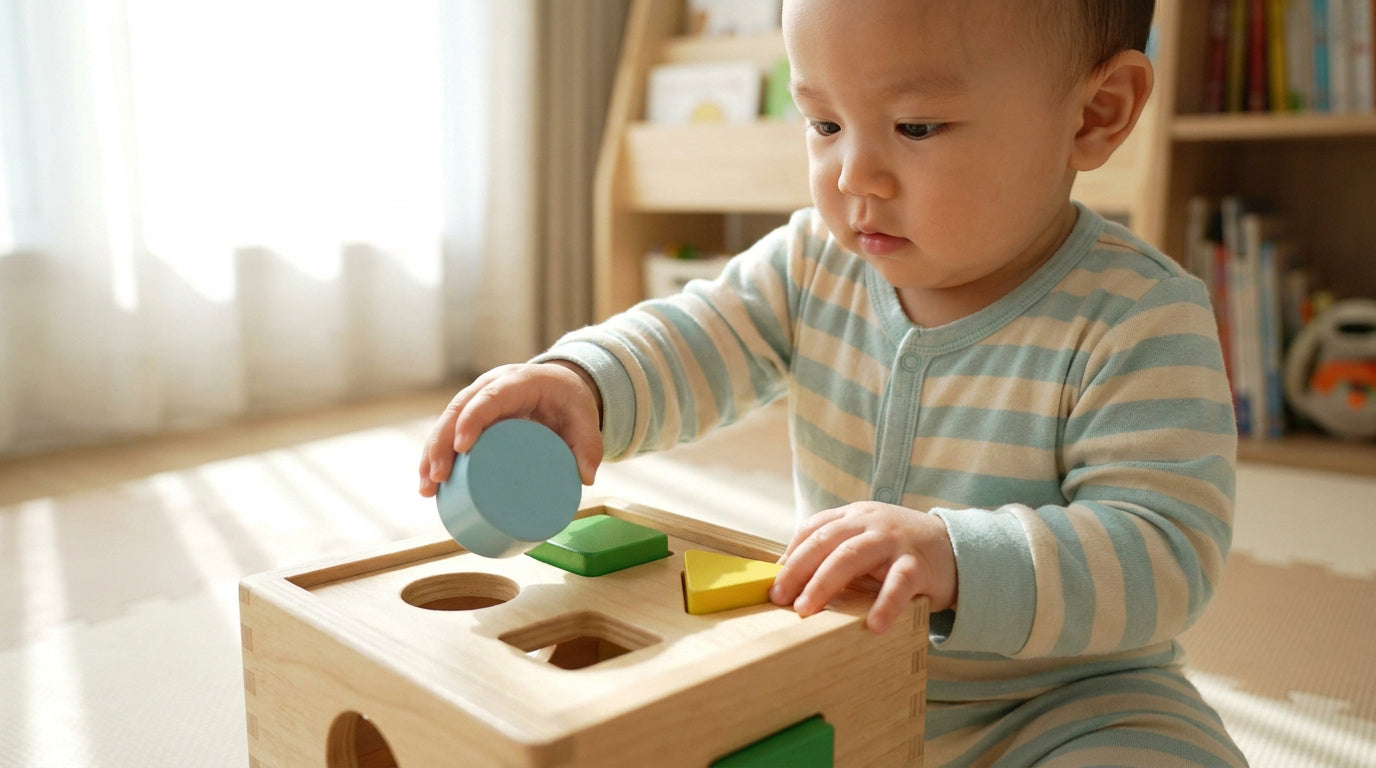
From the age of 6 months, an infant begins to perceive that objects continue to exist even when they move out of their field of vision. The acquisition of this cognitive skill, called object permanence, marks a decisive turning point in their psychomotor development and their understanding of the physical world.
However, given the multitude of models available, identifying the ideal tool to support this stage without generating frustration proves complex. We break down the essential criteria for choosing a Montessori shape box that will secure your child's development while refining their manual precision.
- Why is the Montessori shape box a cornerstone of early development?
- Wooden Montessori magnetic tangram: stimulating chromatic creativity
- Montessori wooden board: associating numbers with geometric volumes
- Montessori DIY construction set: understanding technical structure
- 3 criteria for selecting a box adapted to your baby
Why is the Montessori shape box a cornerstone of early development?
The Montessori permanence box validates the understanding that objects exist out of sight from 6 months. This certified wooden material secures the acquisition of fine motor skills and spatial logic by focusing on disappearance and reappearance.
Cognitive understanding that objects continue to exist even when they are no longer visible or audible to the infant.
Mastering object permanence and spatial logic
The child understands that the ball in the drawer has not vanished into thin air. This is a major cognitive milestone. They finally grasp the continuity of the physical world.
The reappearance of the object provides a sense of mastery. This reduces anxiety linked to separation. Your baby will repeat the action to confirm their theory.
The permanence box transforms the anxiety of loss into a logical, predictable, and reassuring game for the infant.
Developing manual dexterity and ocular precision
The child adjusts their movement so that the shape fits into the slot. It is an exercise of intense visual precision. You will thus stimulate their natural concentration.
Grasping a ball engages the small muscles of the hand. This indirectly prepares for holding a pencil in the future. Repetition forges lasting dexterity.
By handling these objects, your child develops overall fine motor skills. Which Montessori shape box should you choose for a baby? Prioritize non-toxic wood.
From 6 months
100% natural wood
Wooden Montessori magnetic tangram: stimulating chromatic creativity
After consolidating the foundations of permanence, the child can explore more complex spatial composition through colors.
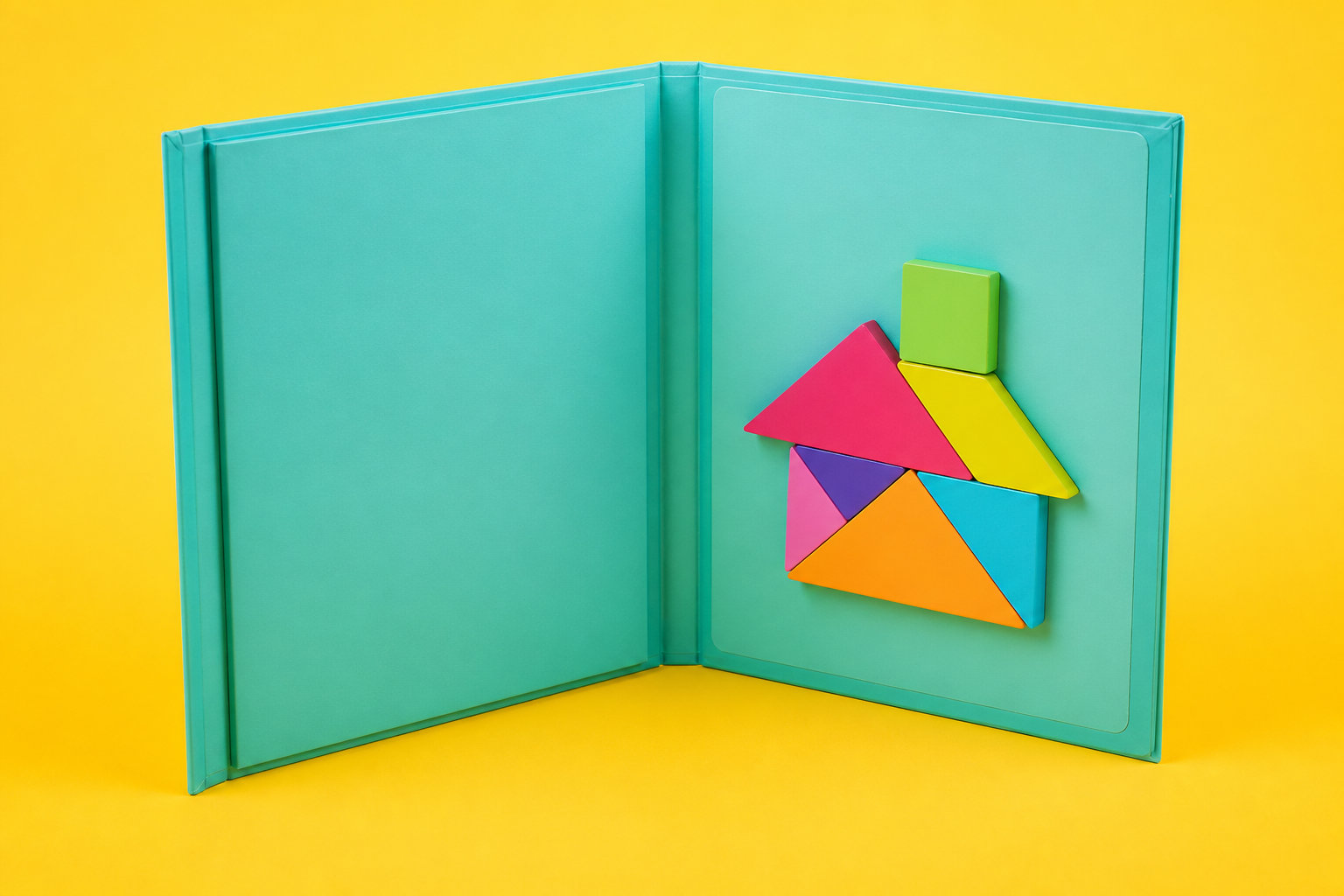
This tangram stands out as a formidable plane geometry tool. Its magnetic pieces greatly facilitate handling on the dedicated support. Your child creates figures without the frustration of slipping.

We favor this Montessori magnetic tangram for its immediate visual appeal. Bright colors capture attention, while geometric shapes structure thought. Which Montessori shape box should you choose for a baby? This magnetic model offers a concrete answer.
Here are the observed benefits during its use:
- Learning primary colors.
- Recognition of triangles and squares.
- Development of figurative imagination.
The magnetic format ensures a highly practical portable aspect. It is the ideal game to occupy the mind during your travels.
Montessori wooden board: associating numbers with geometric volumes
Shape recognition leads naturally to mathematical abstraction and concrete counting. This educational material allows for associating the written number with its real quantity. Your children touch the raised numbers to physically move from the concrete to the abstract.
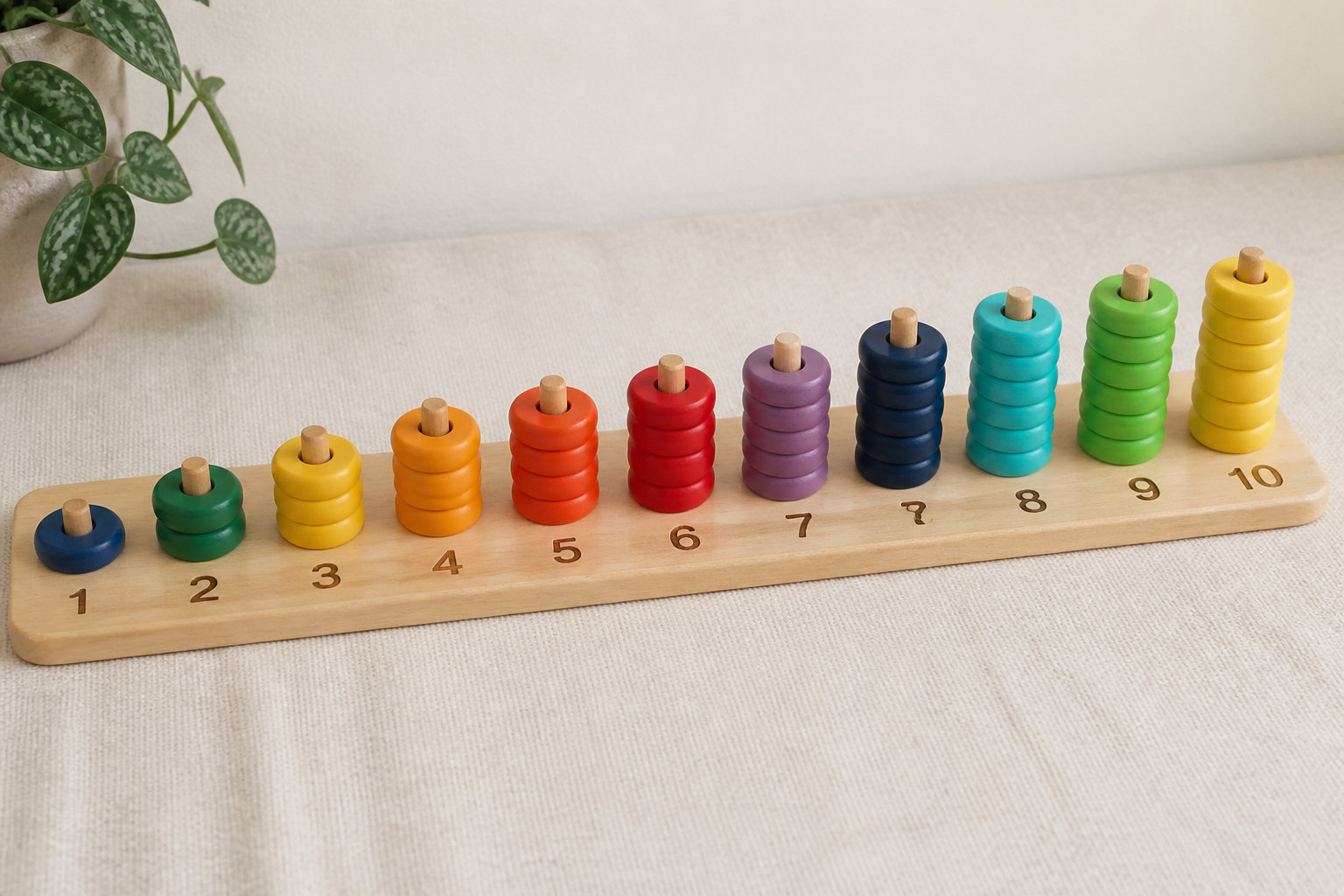
The use of a Montessori wooden board for learning to count promotes lasting memorization. You will find colored rings that are essential for visualizing distinct units. Each stacking helps structure the logical and mathematical thinking of your little explorers.

| Skill | Material used | Pedagogical goal |
|---|---|---|
| Counting | Rings | Understanding units |
| Sorting by shape | Wooden blocks | Visual discrimination |
| Number recognition | Engraved symbols | Memorizing symbols |
Wood offers a warm and noble texture. Your children better memorize geometric shapes through repetitive touch. It is a guarantee of quality and durability for their development.
Montessori DIY construction set: understanding technical structure
Once volumes are mastered, the little builder seeks to assemble elements to create complex structures.
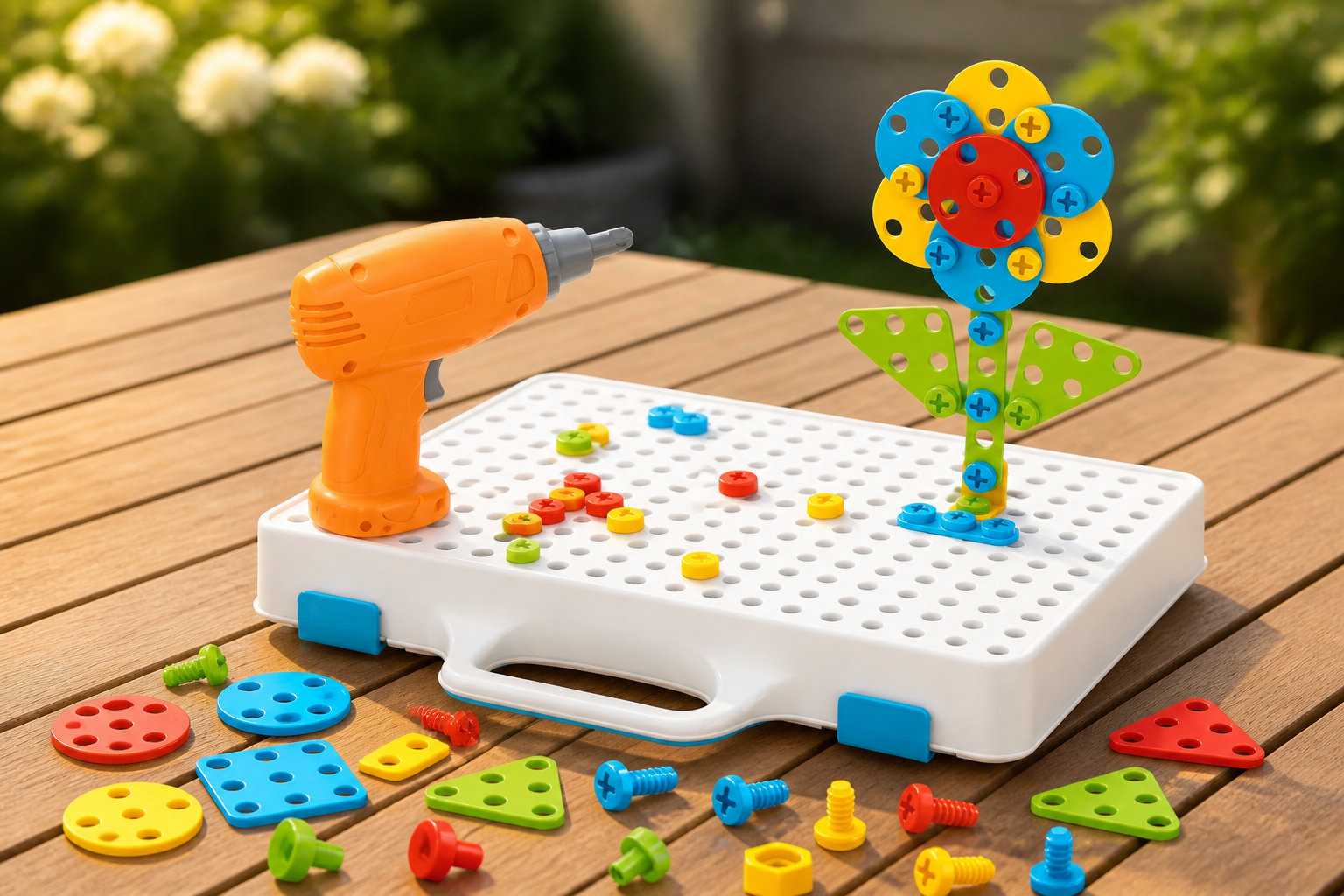
The concept relies on precise screwing and assembly. Your child uses tools adapted to their small hand. They thus understand simple mechanical principles without any frustration.

This Montessori DIY construction set promotes bilateral coordination. Handling these pieces stimulates technical problem-solving. You then observe real progress in their management of complex gestures. Each success reinforces their desire to explore.
Building and deconstructing allows the child to test the laws of physics while asserting their self-confidence.
This game fosters autonomy. The child follows plans or invents their own machines with obvious pride.
3 criteria for selecting a box adapted to your baby
To guarantee an enriching experience, you must pay attention to the quality and relevance of the chosen material.
Focus on the nobility of wood and the harmlessness of paints
Prioritize solid wood for its durability. It is a healthy material that resists impacts. Tactile sensations are superior to plastic.
Check compliance with safety standards, the absence of small detachable parts, and the use of non-toxic water-based paints.
Verify the non-toxic water-based paints. Babies often put objects in their mouths. Safety remains your absolute priority.
Sanded finishes prevent splinters. A smooth material respects your child's fragile skin.
Adjusting mechanism difficulty to the stage of development
Observe your child's attempts. If they succeed without effort, move to the next level. If they get frustrated, the challenge may be too great.

Set up a clutter-free play space. Present only a few items at a time. This encourages concentration and order.
Which Montessori shape sorter should you choose for a baby? The answer lies in progression with this Montessori balancing game.
Opting for a sustainable wooden Montessori shape sorter guarantees your baby a serene mastery of object permanence and refined fine motor skills. By choosing safe materials and adapted mechanisms, you turn every interaction into an immediate cognitive victory. Offer this pillar of development today to build your child's confidence and spatial logic for the long term.
FAQ
At what age is it appropriate to offer a Montessori shape sorter to your baby?
From the age of 6 months, you can introduce this material into your child's environment. This is when the infant begins to explore object permanence, a fundamental cognitive stage where they realize that what disappears from their sight continues to exist.
Depending on their motor development, your baby will first use simple models with a single ball, before moving on to more complex boards or construction toys around age 3. The key is to respect their pace to encourage confident autonomy without creating frustration.
What are the concrete benefits of this material for your child's development?
Using a shape sorter intensely stimulates fine motor skills and hand-eye coordination. By manipulating wooden shapes, your child refines the precision of their movements and strengthens the small muscles in their hand, indirectly preparing them for future pencil grip.
On a cognitive level, this game stimulates spatial logic and problem-solving. Your baby learns to discriminate between shapes and colors while developing their concentration span. It is a comprehensive exercise that transforms simple manipulation into a true conquest of concrete intelligence.
How to select a shape sorter that ensures total safety?
We strongly recommend prioritizing noble materials like solid wood, recognized for its durability and healthy nature. Ensure that the finishes are perfectly sanded and that the paints used are water-based and non-toxic, as toddlers often explore objects with their mouths.
Also, verify that the size of the pieces is suitable to eliminate any risk of ingestion. Equipment that complies with current safety standards is the guarantee of a serene developmental experience, for both you and your child.
Why prioritize wood over plastic for these educational toys?
Wood offers a sensory richness and a warm texture that plastic cannot match. This tactile stimulation helps your child better memorize shapes and volumes. Additionally, it is an ecological material that is resistant to impacts, ensuring exceptional longevity for the toy.
Investing in a wooden box means choosing a timeless object that can be passed down to siblings. This robustness ensures that the mechanism, whether it is a drawer or a lid, will remain functional despite the repeated and enthusiastic handling by your little explorer.
How to maintain your child's Montessori material for the long term?
To preserve the shine and hygiene of your wooden objects, a simple cleaning with a slightly damp cloth is more than enough. It is crucial to avoid total immersion in water, as moisture could alter the natural structure of the wood and damage the finishes.
After cleaning, let the pieces air dry naturally. Regular and gentle maintenance helps preserve all the pedagogical and aesthetic properties of the material, thus ensuring years of playful discoveries for your family.
Pour passer à la pratique
Les jouets qui vont avec cet article
 Montessori 3-in-1 Sorting Box, Shapes and Colors 29,90 €
  Montessori Matching Eggs, Shapes and Colors 24,90 €
  Montessori Sorting Kit: Learn with Dinosaurs 19,90 €
 Livraison offerte dès 50 € · Retour 20 jours