
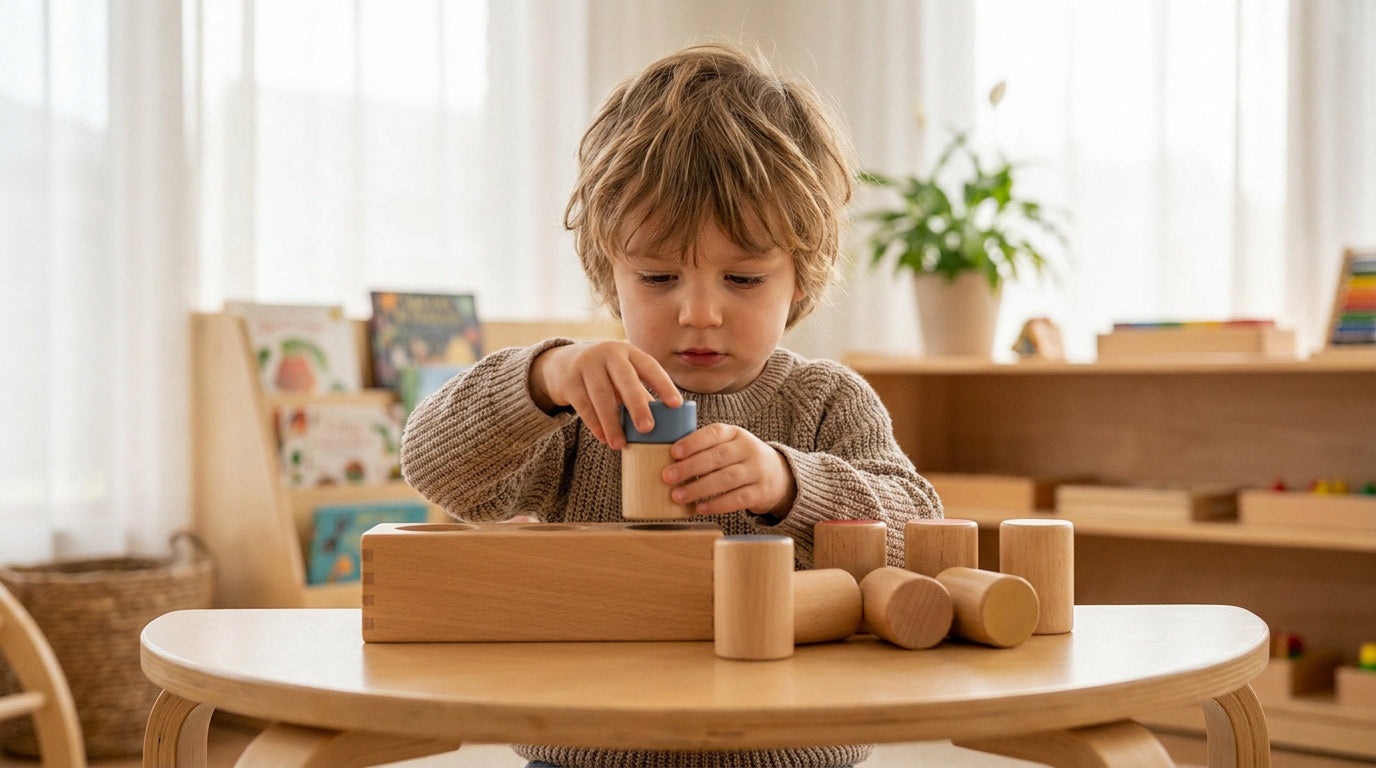

Montessori cylinder blocks form the foundation of visual discrimination by precisely isolating variations in dimensions for children from 2.5 years old. However, many parents observe that without perfectly machined material, the child quickly loses focus when faced with pieces that do not fit well or lack logical consistency.
We will examine how this classic of sensory development structures the logical-mathematical mind and prepares the hand for writing. This guide helps you to master the technical nuances of the four sets to transform every manipulation into an autonomous and rewarding achievement.
- Montessori cylinder blocks: mastering this pillar of sensory material
- What are the real benefits for your child's development?
- Practical guide for successfully presenting the cylinders
- Optimizing the environment with complementary material from Royaume Montessori
Montessori cylinder blocks: mastering this pillar of sensory material
The four solid wood Montessori blocks isolate dimensions in sets of ten cylinders. This sensory material develops visual discrimination, the writing grip, and autonomy thanks to built-in mechanical error control, thereby preparing the child for the technical variations of each set.
To effectively support your child in this fundamental learning process, it is useful to precisely understand the structure of each tool.
Technical analysis of the four dimension sets
Block 1 varies in diameter and height, block 2 only in diameter, block 3 in inverse diameter, and block 4 in height. Each set includes ten solid wood cylinders. The dimensions evolve consistently to offer a perfectly calibrated visual challenge.
The wood is smooth for pleasant handling. The grasp knobs facilitate precise gripping. This durable material withstands repeated use. The quality of the wood ensures perfect stability for sensory development.
- Block 1: Variable height/diameter.
- Block 2: Variable diameter.
- Block 3: Inverse diameter.
- Block 4: Variable height.
The role of error control in autonomy
If a cylinder is placed incorrectly, another will not be able to enter its slot. The child notices this on their own without the help of an adult. This mechanical correction fosters deep concentration. The material then becomes the only guide.
Visual validation is immediate when all cylinders are flush with the block. The child feels a great sense of personal satisfaction. Their self-confidence grows with every success. Perfect insertion requires millimeter-precise machining.
Self-correction is the heart of Montessori pedagogy, allowing the child to turn their errors into discoveries without depending on the adult's judgment.
What are the real benefits for your child's development?
Beyond the purely technical aspect, this sensory material acts as a true catalyst for your child's cognitive and motor skills.
Refining visual discrimination and mathematical logic
Observe your child analyzing volumes. They learn to distinguish thick from thin or tall from short. This sensory perception prepares their mind for future geometry concepts.
Make the connection with mathematics. The ratios of size introduce the concept of series and order. It is a solid foundation for understanding measurements and volumes later on.
The weight of the cylinders varies with their size. This dual sensory information strengthens the memorization of concepts.
Preparation for writing through the writing grip
Focus on the quality of the grip. The child grabs the cylinder knob with the thumb, index, and middle finger. This gesture exactly reproduces the position for holding a pen.
The three-finger grip (thumb, index, middle finger) on the cylinder knobs directly prepares the hand for holding a pen or pencil correctly.
Repeated manipulation strengthens the hand muscles. This indirect preparation will make learning calligraphy fluid and less tiring. It is a major asset for their future schooling.
Placing the cylinder requires great hand-eye coordination. It is an exercise in fine motor skills that is essential on a daily basis.
The impact on concentration and self-confidence
The child becomes totally immersed in their orderly activity. This repetition calms their mind. It develops their ability to remain attentive to a complex and long task.
Successfully putting away all the cylinders provides a sense of pride. The child feels capable and autonomous. It is an essential pillar for their emotional development and self-esteem.
The structured environment soothes your little one. They work in constructive silence that promotes their personal growth.
Practical guide for successfully presenting the cylinders
For these benefits to materialize, the way you introduce the activity to your child is decisive for their future engagement.
The order of presentation and precise gestures
Present the method with care. Take the cylinders out from left to right on the table. Place them randomly in front of the block, then put them back. Your movement must remain slow and silent.
- Take out the cylinders from left to right.
- Arrange them randomly.
- Replace them silently.
- Master one block before the next.
The adult should not speak, so as to let the child observe their hands. Visual observation is more effective than useless verbal explanations.
Favor a progressive introduction. Start with a single block. Add the following ones only when the first is completely mastered.
Enriching vocabulary through sensory contrasts
Introduce precise terms such as thick, thin, tall, or short. Associate each adjective with a specific cylinder to directly link the word to the physical sensation.
Use the three-period lesson. Name the object, ask the child to point to it, then to name it. This firmly anchors the sensory lexicon.
Slide the child's fingers over the edge of the wood. This tactile contrast helps to understand the adjective used for each dimension.
Adapting the activity according to age and difficulties encountered
Adapt according to age. At 12 months, the child manipulates for the pleasure of the movement. At 3 years old, they seek the perfect precision of the sets.
If a cylinder gets stuck, remain calm. Show how to remove it gently. Turn this incident into a lesson in patience and perseverance.
Suggest playful variations. Use a blindfold for tactile exploration. This considerably increases the sensory challenge offered.
Optimizing the environment with complementary material from Royaume Montessori
Once the foundations have been laid with the cylinders, you can enrich your child's learning space with tools that extend these fundamental lessons.
Extending mathematical and geometric awakening
Introduce numerical tools. This Montessori wooden counting board allows for tackling the first numerical operations in a concrete way. You thereby promote lasting understanding.
Introduce shapes. The magnetic tangram helps to create complex figures using the spatial logic acquired. Your child then explores varied geometric structures.
Reinforcing fine motor skills through play
Work on precision. These games, such as the Montessori DIY set or the wooden beehive, require perfect mastery of slow movement. Dexterity is refined naturally.
Master balance. This natural wood material, such as the balance game, promotes concentration. The child then plays with fundamental physical laws in total autonomy.
Varying sensory challenges in daily life
Incorporate practical life. This busy board offers everyday gestures essential for autonomy. Each manipulation reinforces confidence in their motor abilities.

Diversify your approaches. The monkey balance scale perfectly complements the weight exploration begun with the cylinder blocks. It allows for the concrete visualization of measurements and balance.
| Material | Main objective | Ideal age |
|---|---|---|
| Cylinder blocks | Visual discrimination | From 2 and a half years |
| Counting board | Calculation | From 3 years |
| Tangram | Geometry | From 4 years |
| Busy Board | Fine motor skills | From 18 months |
Mastering the Montessori cylinder blocks refines visual discrimination and prepares the hand for writing through the pincer grasp. Integrate this sensory pillar now to offer your child lasting autonomy and absolute confidence in their abilities. Transform every mistake into a quiet victory toward mathematical excellence.
FAQ
At what age can you introduce cylinder blocks to your child?
This iconic Montessori material is generally introduced from the age of 2 and a half. It is during this period that the child shows a growing interest in order and fine sensory exploration.
However, it is essential to respect the biological rhythm of your little treasure. Some children will be ready slightly earlier, while others will prefer to dive in around age 3, when their pincer grasp begins to naturally refine.
How are the four series of blocks precisely composed?
Each series is an invitation to discover a specific dimension. Block 1 varies in diameter and height, block 2 only changes the diameter, block 3 offers an inverse variation (the diameter increases as the height decreases), and block 4 focuses exclusively on height.
This rigorous structure allows for the isolation of difficulties to provide a perfectly calibrated visual challenge. Each block contains ten solid wood cylinders, ensuring logical progression and handling of great tactile quality.
Why is the control of error fundamental in this activity?
The control of error is the true secret to Montessori autonomy. If your child places a cylinder in the wrong housing, they will inevitably end up with a piece that is too large or too small at the end of the exercise. This mechanical and visual correction allows them to understand their error without any intervention on your part.
By self-correcting, the child turns every hesitation into a personal victory. This significantly strengthens their self-confidence and capacity for concentration, as they become the sole master of their learning and success.
What are the concrete benefits for learning to write?
Handling the small knobs located on each cylinder is a direct and valuable preparation for calligraphy. By grasping the knob with the thumb, index, and middle finger, your child builds strength in their hand and adopts the exact posture required to hold a pen.
This fine motor work, performed beforehand, will make learning to write much more fluid and less tiring for them. It is a concrete investment in their future academic journey, combining precision of movement with the pleasure of play.
How can you maintain your solid wood materials for the long term?
The robustness of solid wood ensures exceptional longevity for your cylinder blocks. To preserve the smooth and safe appearance of the material, regular, simple cleaning with a dry or slightly damp cloth is more than enough to remove traces of handling.
Avoid using harsh chemical products that could alter the quality of the wood. Minimal maintenance ensures that this material remains a durable investment, capable of lasting through the years while maintaining its millimeter precision.