
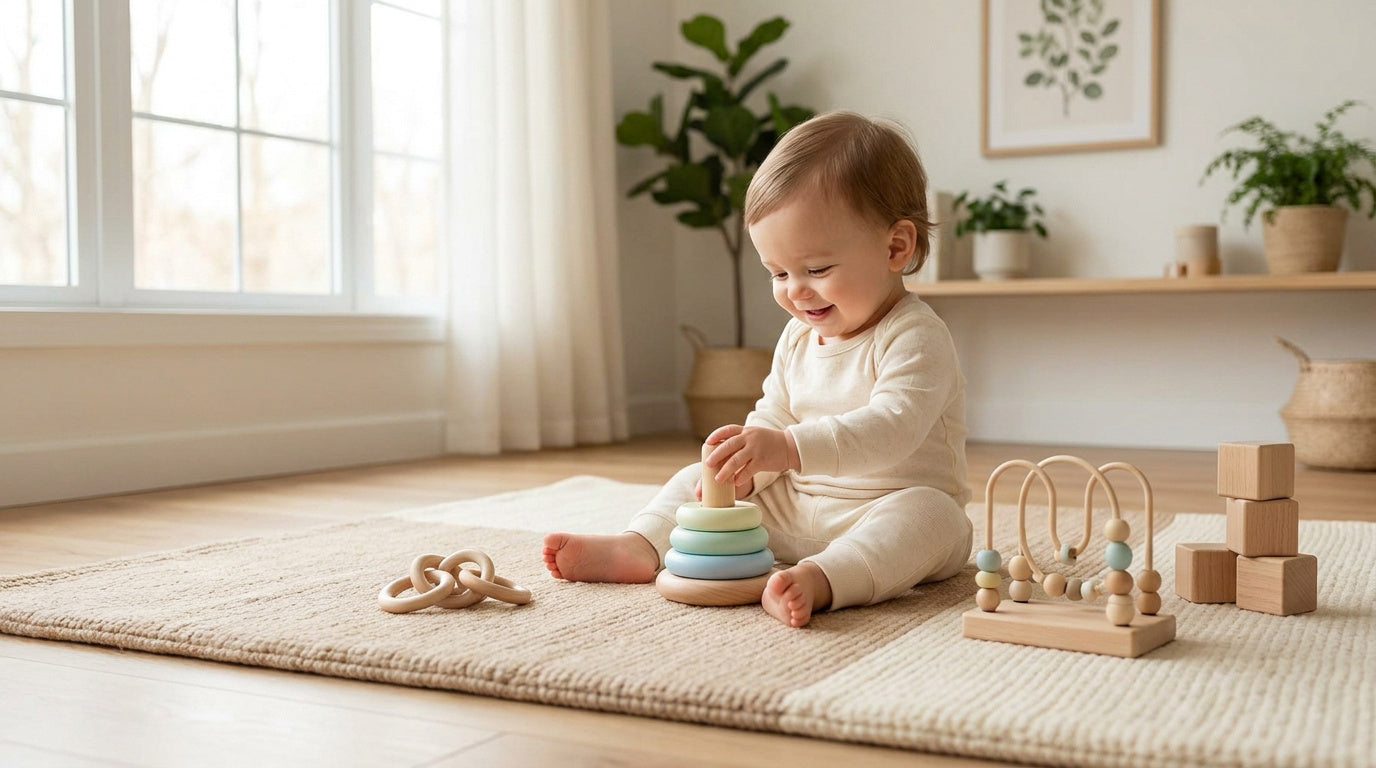

Solid wood and natural fibers form the basis of a healthy environment, offering the newborn rich and authentic tactile sensations. Choosing a Montessori birth gift means investing in a durable object that respects the biological rhythm and safety of the child without any chemical components.
We often end up accumulating noisy electronic toys that limit creativity and saturate the attention of the little ones. We will help you select refined developmental supports that promote real autonomy and deep concentration from the first months.
- Criteria for choosing a durable Montessori birth gift
- Wooden Montessori beehive for learning colors
- Montessori Busy Board to master everyday gestures
- Wooden Montessori Magnetic Tangram for spatial logic
- Montessori DIY construction game for creativity
- Montessori balance game for patience and dexterity
- Montessori car track to improve concentration
- Wooden Montessori board to introduce mathematics
- Montessori Monkey scale to understand quantities
Criteria for choosing a durable Montessori birth gift
An authentic Montessori gift prioritizes untreated wood, organic cotton, and the isolation of a single sensory difficulty. These durable items promote autonomy and freedom of movement, excluding any electronic components or toxic plastic for optimal safety.
The search for safety for the newborn logically leads to a rigorous selection of components and the robustness of the objects.
Natural materials and object safety
Favor raw wood and natural fibers. Contact with organic cotton preserves the infant's fragile skin. It is a healthy choice.
Scrupulously check the safety standards. The absence of chemical varnishes and detachable parts avoids any risk of ingestion. Vigilance is the priority here.
The object must demonstrate exemplary robustness. It must withstand impact. Its longevity guarantees peaceful use over several years.
Sobriety and active sensory development
Isolating the difficulty is essential. A relevant toy offers only one action. This prevents any unnecessary cognitive overstimulation in the child.
Favor active objects over battery-operated gadgets. The child becomes the actor of their discovery. Their engagement is then total and constructive.
Opt for a sleek design. These choices foster deep concentration. They do not scatter the attention of the budding little explorer.
- A single dominant color.
- A single texture to explore.
- Absence of electronic sounds.
- Weight adapted to the infant.
Wooden Montessori beehive for learning colors
After defining the selection criteria, let's focus on a classic that perfectly illustrates fine motor manipulation: the wooden beehive.
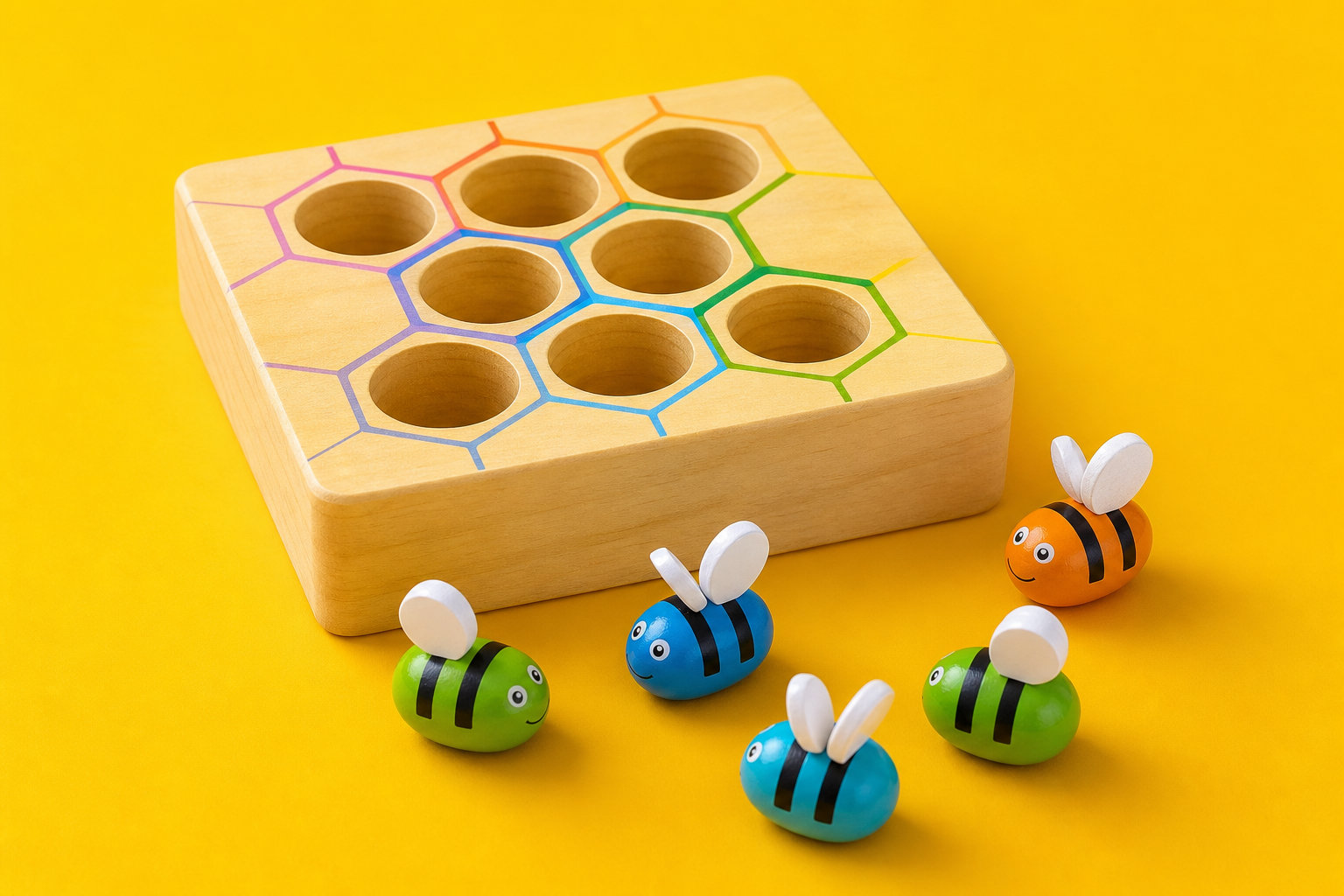
The Wooden Montessori Beehive is an exceptional didactic tool. Your child uses ergonomic tweezers to place each bee in its honeycomb. This precise movement strengthens hand-eye coordination. It is a remarkable exercise to strengthen the grip.
Manipulating the tweezers in the beehive game directly prepares the child's hand for holding a pencil later on.

The color-sorting aspect structures the mind. Each bee joins its dedicated chromatic habitat. The child thus classifies visual elements. They forge their logic intuitively.
Natural wood guarantees exemplary durability. This noble material remains healthy and robust. It lasts for generations without losing its appeal.
Learning becomes pure pleasure. The child gains serenity. Their concentration becomes total.
Montessori Busy Board to master everyday gestures
Beyond sorting, autonomy also comes from mastering the real mechanisms found on the activity board.
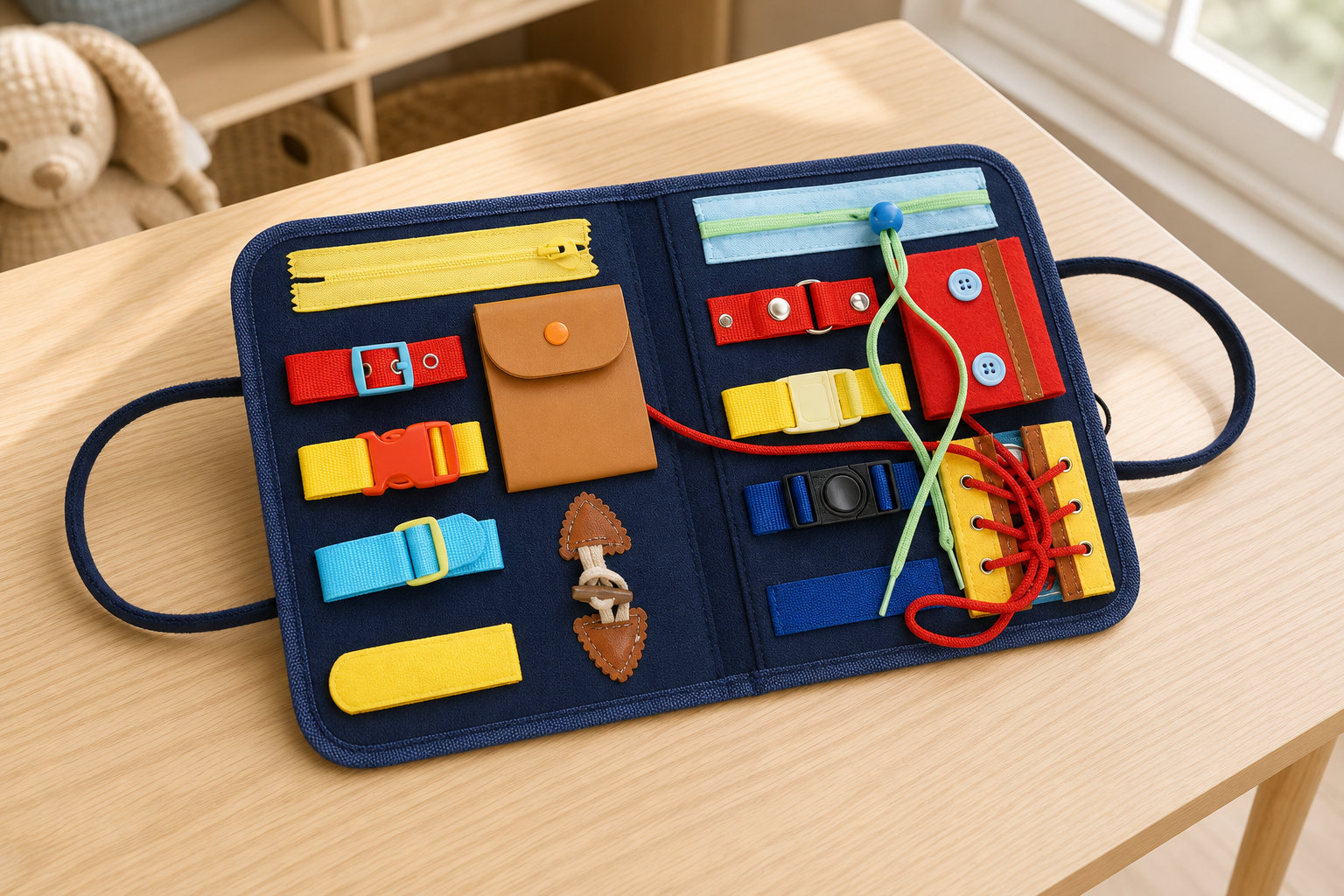
The Montessori Busy Board stands out as a remarkable developmental tool. This support gathers latches, zippers, and tactile gears. Your child thus explores these everyday objects in complete safety.

Manipulating these concrete elements directly promotes the learning of practical life skills. These exercises help the toddler become autonomous in dressing themselves. It is a rewarding challenge that reinforces their self-confidence.
These activities capture attention for long minutes, fostering prolonged concentration. The child develops real perseverance when faced with technical problems. This is where true polarization of attention lies.
This wooden board has the advantage of being compact and easily portable. It intelligently keeps your child occupied during all your trips.
Wooden Montessori Magnetic Tangram for spatial logic
Once the gestures are mastered, the child's mind can turn toward abstraction and geometry with magnetic puzzles.
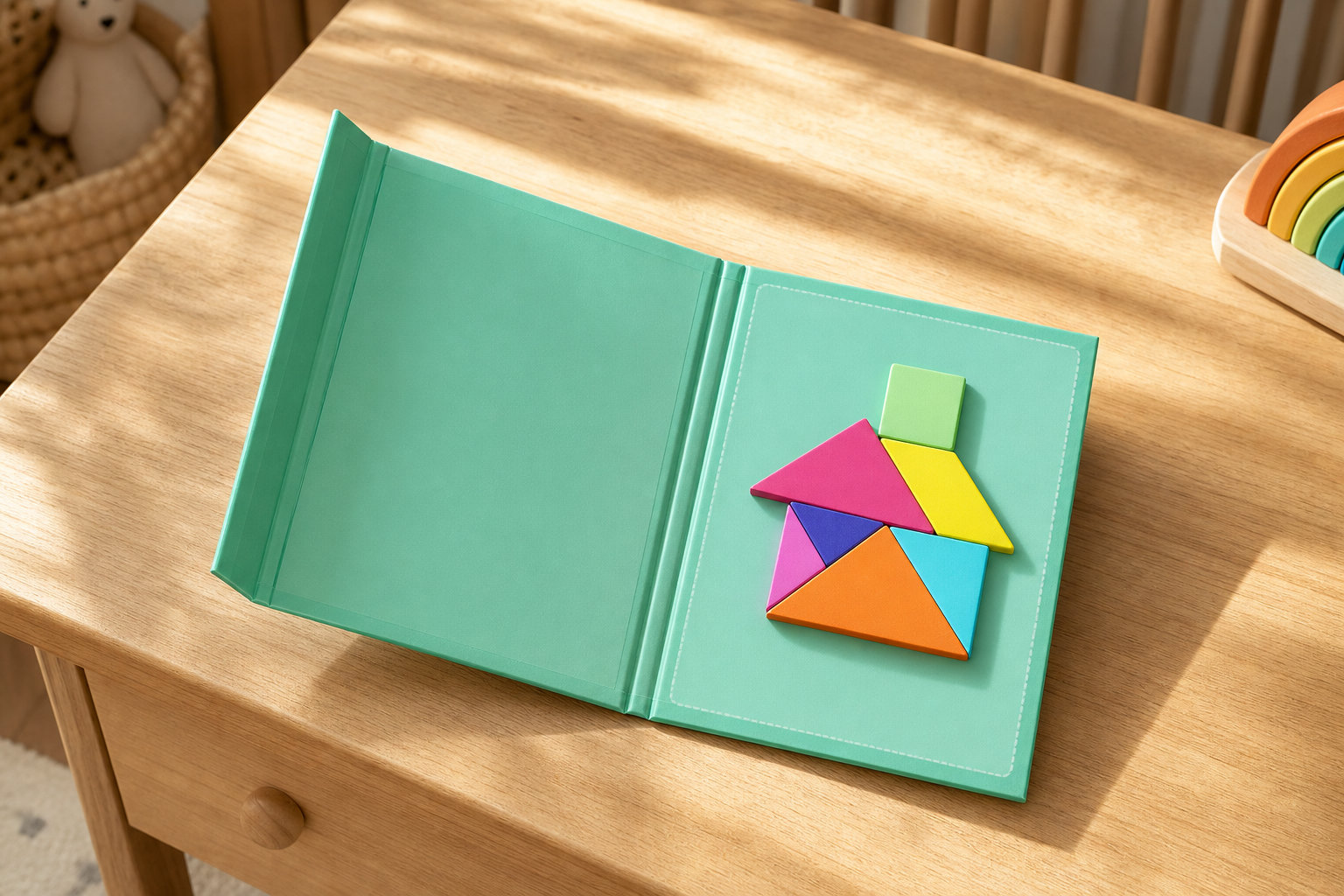
The Wooden Montessori Magnetic Tangram allows for composing various figures. This game strongly stimulates spatial vision. The magnetic pieces facilitate placement.

You will appreciate the importance of geometric shapes conveyed here. The child discovers triangles, squares, and parallelograms. They understand how to assemble parts. It is very instructive.
This support fosters free creativity. One can follow patterns or invent one's own designs. This encourages imagination without strict limits. The child expresses themselves fully.
The durability of wood remains a major asset. The pieces are pleasant to the touch. They do not slip.
Montessori DIY construction game for creativity
Creativity is intensely expressed when the child builds in three dimensions. The Montessori DIY Construction Game offers adapted screws and plates. Your child then becomes a budding architect.

Screwing and assembling requires surgical precision, which strengthens finger muscles. This fine motor skill practice effectively prepares for writing. It is a manual exercise that is as technical as it is fun.
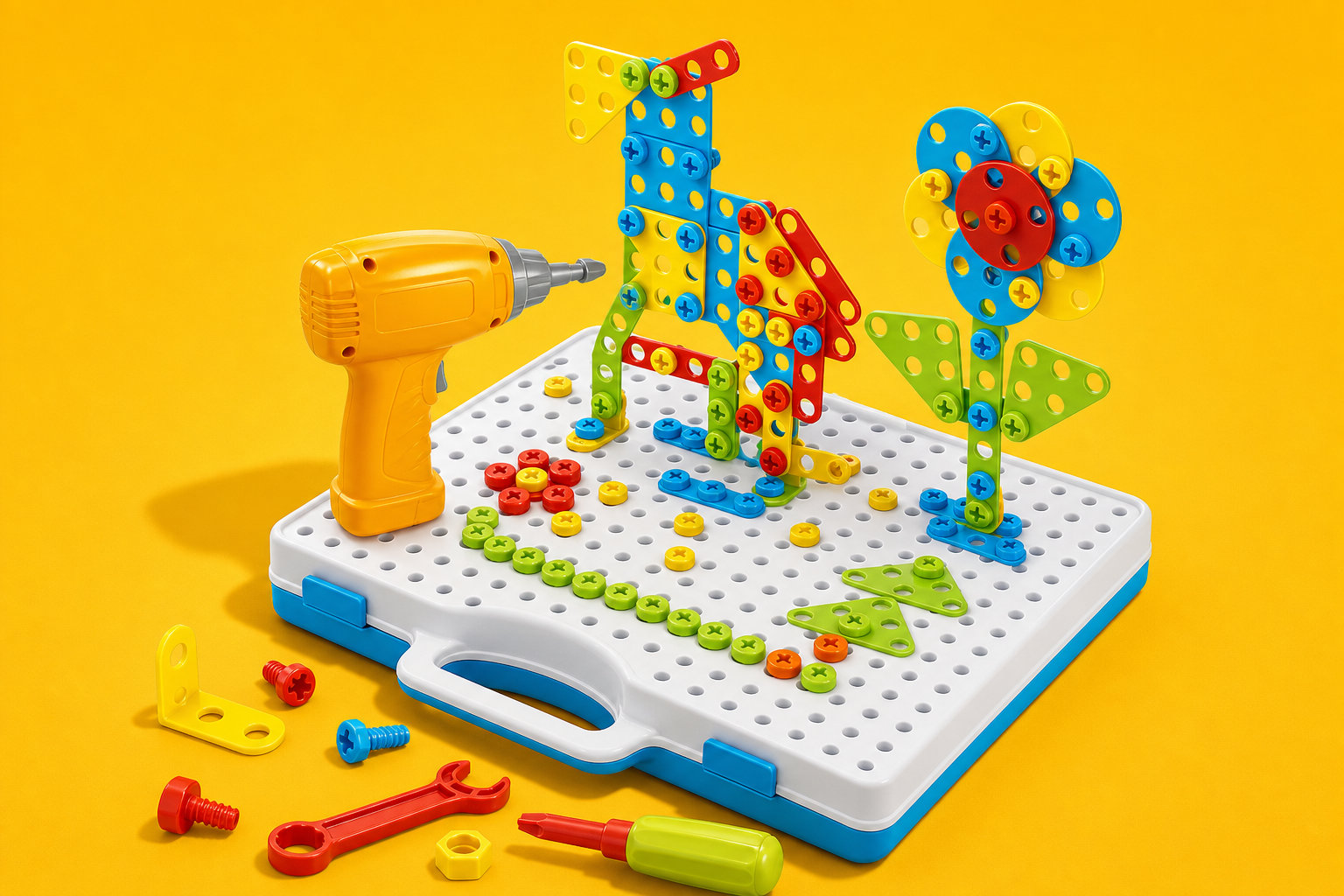
The child solves concrete problems to stabilize their structures. They learn from their mistakes through direct experimentation. This logical approach proves extremely rewarding for their autonomy.
The lightweight case uses non-toxic and durable materials. It facilitates quick cleanup after each session. You thus ensure an orderly and safe environment.
Montessori balancing game for patience and dexterity
After solid construction, the child tests stability. Offering this Montessori Balancing Game encourages Olympian calm. Concentration is at its peak.

Each movement must remain slow. Your child thus refines their manual dexterity. It is a true exercise in patience.
The colorful shapes catch the eye. This wooden object stimulates the desire to manipulate. It also decorates the room beautifully.
Share this moment as a family. Taking on challenges together strengthens your bonds. Play becomes social learning.
| Suggested age | Target skill | Material | Difficulty |
|---|---|---|---|
| 18 months+ | Precision | Wood | ⭐⭐ |
| 12 months+ | Autonomy | Wood | ⭐⭐ |
| 3 years+ | Logic | Wood | ⭐⭐⭐ |
| 3 years+ | Motor skills | Wood | ⭐⭐⭐ |
Montessori car track to improve concentration
Continuous movement also offers a source of fascination that helps stabilize visual attention.
This vertical car track offers a captivating spectacle where vehicles cascade down the slopes. This mechanical repetition naturally calms children from 18 months onwards. It above all promotes essential dynamic visual tracking.

Releasing the car at the top causes an immediate controlled fall. Your child quickly grasps this simple physical principle of cause and effect. They then start over tirelessly to validate their observation.
FSC-certified wood ensures a minimalist environment, far from shrill noises. Only the soft sound of rolling animates the room. It is deeply restful for your senses.
Replacing the car precisely on the track requires an adjusted gesture. Your child thus refines their fine motor skills with determination.
Montessori wooden board to introduce mathematics
Moving away from pure movement, we introduce numbering through touch. The Montessori Wooden Board allows for the manipulation of numbers and rings. The child associates the symbol with the quantity. It is concrete.

Addition exercises become visual on the pegs. By adding rings, calculation becomes logical. The child understands without effort. They have a lot of fun.
The child's mathematical mind awakens through concrete manipulation before being able to access the pure abstraction of numbers.
The board also includes geometric shapes for insertion. This multiplies discoveries on a single support. The object is very complete for development.
Beech wood ensures ideal robustness. It is durable material for the home. It lasts a long time and remains healthy.
Montessori monkey balance to understand quantities
To perfect this introduction to numbers, the concept of balance provides physical proof of the accuracy of a calculation.
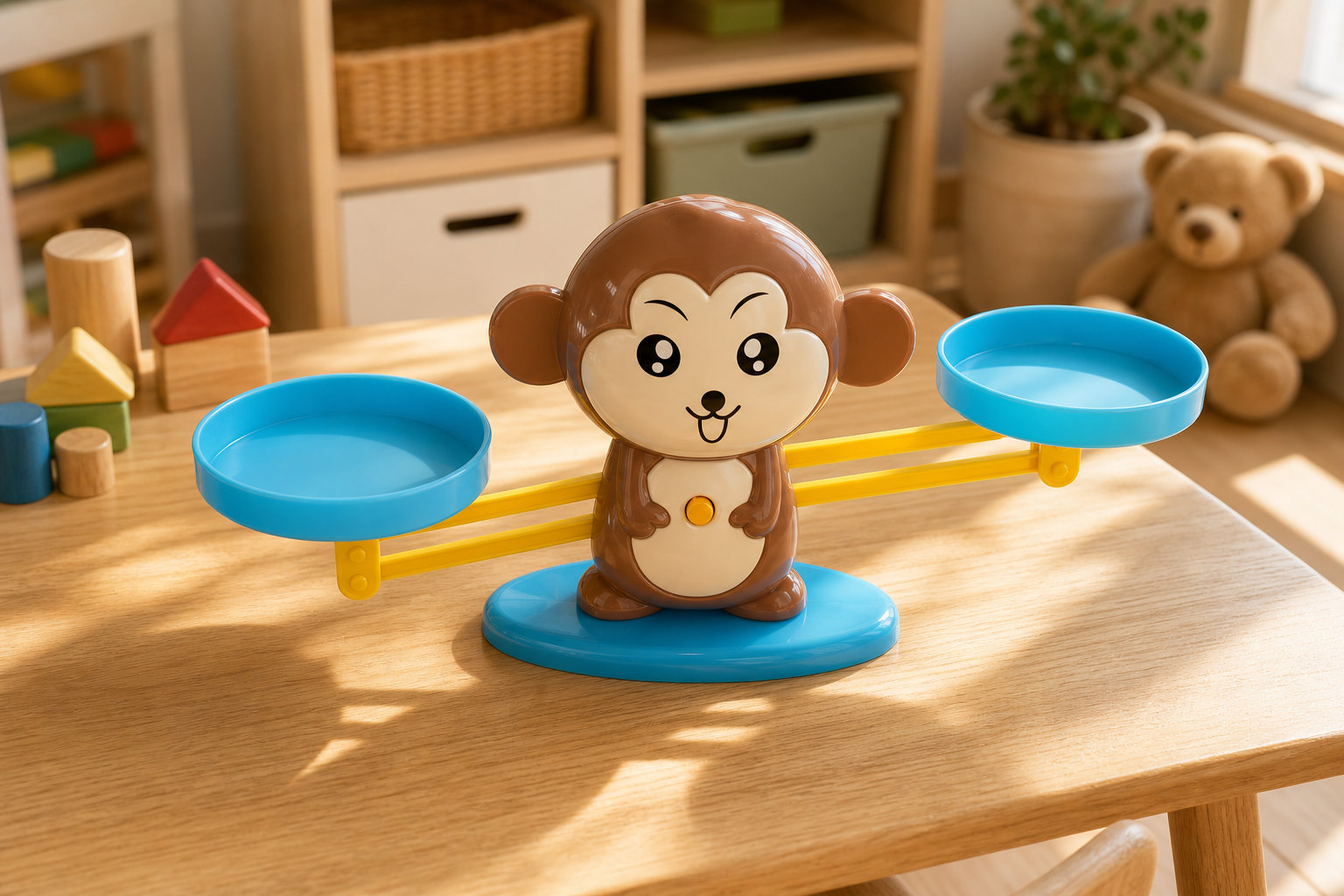
The Montessori Monkey Balance uses the weight of the numbers to stabilize the scales. The child sees immediately if their calculation is correct. This device makes mathematics concrete.

The concept of equality becomes tangible. Place the number three on one side and three monkeys on the other to balance it. It is a fascinating physical demonstration. The child loves manipulating these quantities.
Self-correction promotes independence. The scale tips if the result is wrong, encouraging the child to adjust their pieces on their own. They learn without the constant intervention of an adult.
The little monkey makes numbers friendly. This playful character takes the dread out of arithmetic learning. Mathematics then becomes a serene developmental game.
- Immediate visual feedback.
- Autonomy in error.
- Sensory approach to weight.
- Playful and attractive design.
Choosing a Montessori birth gift ensures healthy sensory development through natural materials and a sober design. By choosing these durable objects, you give the newborn the keys to their future autonomy. Invest in quality now to serenely accompany every step of their precious development.
FAQ
What are the essential criteria for selecting a truly sustainable Montessori birth gift?
To offer a gift that lasts and respects the child's development, you must prioritize noble and natural materials. An authentic Montessori gift is distinguished by the use of untreated wood, organic cotton, or linen, thus ensuring total safety during oral exploration phases. The absence of electronic components, flashing lights, and plastics derived from petrochemicals is a guarantee of quality and peace of mind for the newborn.
Durability also relies on the simplicity of the design. By choosing objects that isolate a single sensory difficulty, you allow the child to focus fully on their discoveries without overstimulation. These objects, often robust and scalable like the learning tower or play mats, accompany the little one's growth for several years, making your gesture a precious investment for their future fulfillment.
Why is it better to choose wooden toys rather than plastic ones for a newborn?
The choice of wood, particularly beech or bamboo, meets a requirement for public health and sensory pleasure. Unlike plastic, which can contain endocrine disruptors such as phthalates or bisphenol A, wood is a healthy, non-toxic, and biodegradable material. Its unique texture and weight offer a much richer and more real sensory feedback for the hands of an infant learning to grasp.
Moreover, the natural robustness of wood ensures exceptional longevity for the product. A wooden toy withstands shocks and repeated handling without breaking into small, dangerous pieces. It is a responsible choice that limits environmental impact while offering the child a noble object that can, in many cases, be passed on among siblings.
How does Montessori pedagogy foster autonomy from a very young age?
Montessori pedagogy relies on the fundamental concept of self-correction and the prepared environment. The tools we offer, such as the Busy Board or the Monkey Balance, are designed so that the child can experiment and understand their mistakes on their own, without the constant intervention of an adult. This approach strengthens their confidence in their own abilities and stimulates their perseverance when faced with a technical or logical challenge.
By offering objects adapted to their strength and size, you allow the toddler to become the main actor in their development. Whether it is mastering the gestures of daily life or grasping initial mathematical notions through concrete manipulation, each tool aims to "help them do it themselves". It is this freedom of action, framed by structured materials, that forges their independence and natural curiosity.
What types of Montessori games do you recommend to stimulate a baby's sensory development?
For the first months of life, you should look toward objects that gently stimulate sight and touch. Grasping balls with varied textures and wooden rattles are perfect for developing hand-eye coordination. Mobiles with simple geometric shapes and organic fabric books also allow for a first visual and tactile approach without the risk of cognitive fatigue.
As the child grows, nesting games, shape sorters, and wooden musical instruments become essential vectors of development. These supports help the baby classify sounds, colors, and volumes. The goal is always to offer active exploration where the infant discovers the laws of physics, such as cause and effect or balance, through their own sensory manipulation.
How to effectively maintain Montessori toys made of wood or organic fabric?
Maintaining these precious objects is simple but requires some attention to preserve their natural properties. For wooden elements, we advise you to use only a cloth slightly dampened with mild soap. It is imperative never to submerge them in water and to let them air dry to prevent the wood from warping or cracking.
Regarding textiles made of organic cotton or wool, machine washing at low temperature with an eco-friendly detergent is generally recommended. We suggest you regularly check the integrity of the seams and the absence of small parts that could detach over time. Regular maintenance not only ensures perfect hygiene for your child, but also ensures the longevity of your educational equipment.