
An infant's motor coordination relies on precise physiological milestones where each manipulated object shapes their future cognitive abilities. But how can you turn those first hesitant gestures into genuine developmental successes?
We often end up accumulating aesthetic toys that overlook the specific ergonomics required by small, growing hands. This article breaks down the virtues of the Montessori grasping ball to help you optimize your child's sensory awakening and autonomy from the age of three months.
- 🎾 Why does the Montessori grasping ball complement the Wooden Beehive?
- 🧩 The Montessori Busy Board to refine dexterity
- 📈 Concrete benefits for motor and sensory development
- 🛠️ A practical guide to using and making the ball
🎾 Why does the Montessori grasping ball complement the Wooden Beehive?
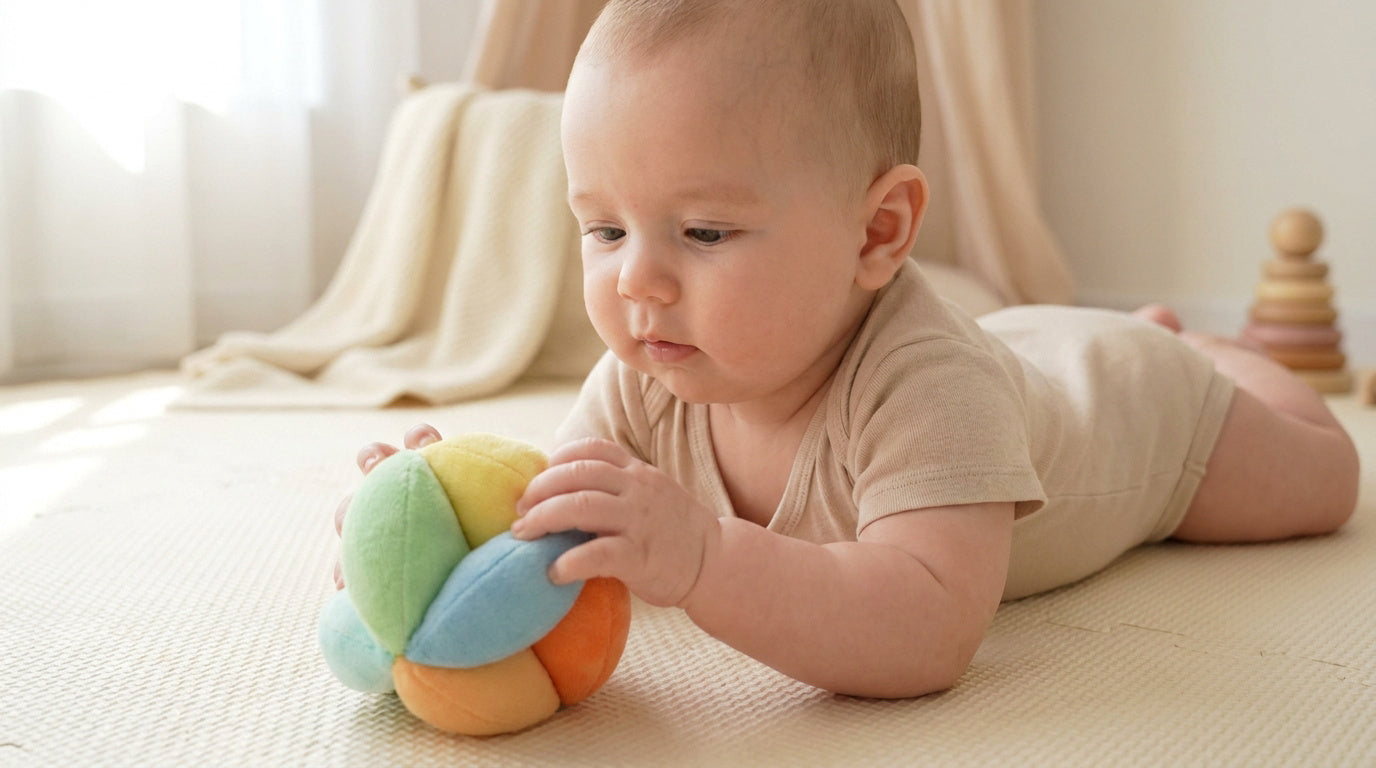
The Montessori grasping ball, with its 12 certified fabric segments, optimizes fine motor skills from 3 months old. It perfectly complements the wooden Beehive at €26.90 for early color learning.
Your child deserves tools adapted to their growth. The transition to digital precision occurs naturally thanks to the Montessori Beehive.
🐝 The Montessori wooden Beehive for chromatic awakening
We recommend the Montessori wooden Beehive sold by Royaume Montessori. This support priced at €26.90 encourages sensory development.
The child manipulates the bees with the tweezers. They learn the primary colors. The natural wood ensures optimal durability.
Fine manipulation prepares the hand for complex objects. It is a logical step toward the ball.

This technical mastery ideally introduces the benefits of the grasping ball for a baby's development.
📐 Ergonomics designed for the success of little hands
The ball has 12 padded triangular segments. Its openwork shape allows for easy gripping from all angles. The child feels no frustration during their attempts.
The cotton and padding offer extreme lightness. The baby can lift the object without excessive muscular effort.
This ergonomic design promotes the first voluntary movements. Motor autonomy begins with these simple successes.
🧩 The Montessori Busy Board to refine dexterity
After mastering grasping the ball, your child will seek more technical challenges like those offered by activity boards.
🛠️ Mastering everyday gestures safely
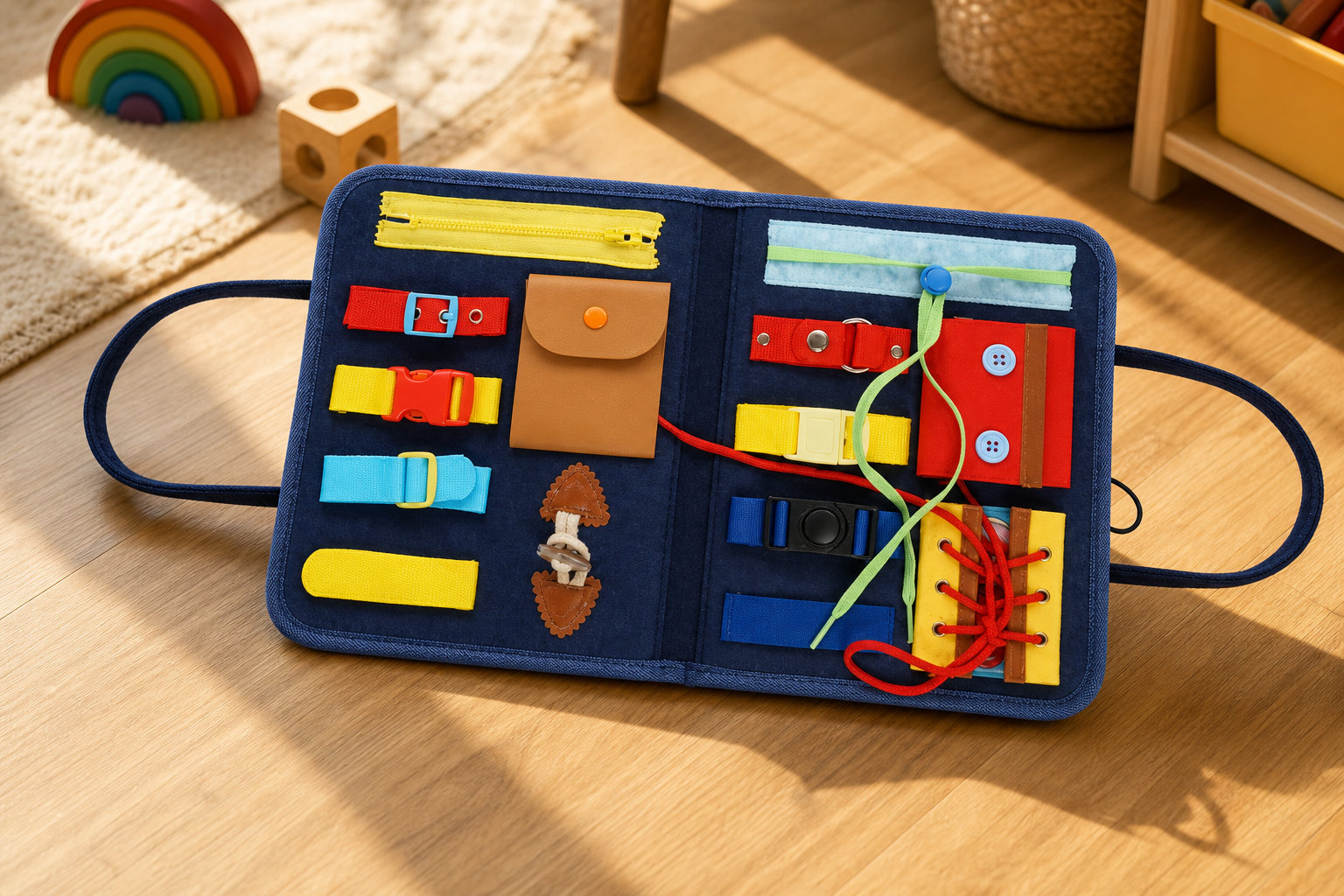
The Montessori Busy Board at €25.90 is an exceptional support. It gathers various zippers and buttons. It is a complete tool for development.

This interactive board offers concrete elements:
- Colorful zippers
- Snap buttons
- Laces to tie
- Belt buckles
The repetition of these precise gestures reinforces autonomy. Your child thus learns to dress themselves while having fun.
🧠 Stimulation of concentration and perseverance
Fine manipulation requires intense mental focus. The child thus remains concentrated on a precise mechanism. This activity develops their natural patience.
The hand is the instrument of intelligence, allowing the child to build their thought through concrete action on their immediate environment.
Successfully completing a complex mechanism provides immense satisfaction. This feeling of real competence boosts self-confidence in the long term.
📈 Concrete benefits for motor and sensory development
Beyond specific objects, let's understand how these tools truly transform the physical and sensory abilities of your infant.
🤝 Hand-eye coordination and muscle strengthening
Passing the object from one hand to the other intensely stimulates your child. This transfer engages both cerebral hemispheres simultaneously. It is a crucial step in cognitive development.
The pressure exerted on the segments effectively tones the wrist. These exercises prepare the hand for future writing with precision. Vision also sharpens by following the moving object. Finger muscles thus strengthen sustainably.
You can also use the Montessori DIY construction set. This tool ideally extends this muscular work for older children.
🌈 Tactile and visual exploration through contrast
Favor quality fabrics like organic cotton or minky. Varying textures directly stimulates your baby's tactile receptors. Touch then becomes a major source of information.
| Material | Tactile sensation | Developmental advantage |
|---|---|---|
| Organic cotton | Natural softness | Safety and comfort |
| Minky | Relief texture | Sensory curiosity |
| Velvet | Deep touch | Tactile soothing |
| Satin ribbons | Slippery and thin | Fine grasping |
Color contrasts greatly promote infant vision. They distinguish vibrant hues or sharp oppositions better. The addition of small bells also stimulates hearing with subtlety.
Always check for the CE marking and Oeko-Tex label. Regularly inspect seams to prevent any filling leakage or choking hazards.
🛠️ A practical guide to using and making the ball
To fully enjoy these benefits, here is how to integrate the ball into daily life and even make it yourself.
👶 Evolution of interactions from birth to 24 months
Suspended, it encourages the first kicks. Placed on the floor, it encourages voluntary grasping. Mobile usage (0-3 months) differs radically from the active manipulation observed later.
Its shape prevents it from rolling too far. The baby remains motivated to reach it. This creates an achievable goal on the floor. In fact, this specific design helps your child to crawl.
Sharing games appear after 6 months. Future interactions take shape right now. To extend this development, discover the Montessori balance game adapted for playful exchanges.

🧵 DIY tutorial and selection of certified materials
Cut 24 fabric triangles. Assemble them in pairs to form the pads. Then sew the segments securely. Stuff with safe batting to promote the benefits of the grasping ball for baby's development.
- Cut 24 triangles.
- Assemble the pads.
- Sew the segments.
- Stuff with care.
- Secure the seams.
Use robust thread. Regularly check the fabric for wear to prevent filling leakage. Safety depends directly on the sturdiness of your handmade work.
A 30-degree wash is sufficient. Air dry to preserve the fibers. Regular maintenance ensures impeccable hygiene for your child's daily explorations.
By stimulating hand-eye coordination and fine motor skills, this Montessori grasping ball constitutes a fundamental pillar of sensory development. Offer your child this ergonomic and secure tool now to transform their first manipulations into real motor victories. Accompany every one of your baby's steps toward radiant autonomy.
FAQ
At what age can my child start manipulating the grasping ball?
You can introduce this developmental tool from about 3 months old. At this stage, your infant begins to develop their visual functions and first voluntary movements, making the ball an ideal support for their initial explorations.
From birth, it can also be suspended to stimulate foot coordination and spatial perception. Its use then evolves naturally with your child up to 24 months, moving from simple observation to more complex tossing games.
What are the real benefits of this toy for my baby's fine motor skills?
The unique geometric structure, composed of 12 triangular segments, is specifically designed to eliminate any frustration. It allows your child to grasp, pinch, and manipulate the object from any angle, thereby strengthening hand muscles and wrist flexibility.
This muscular engagement precisely prepares the hand for future writing movements. By passing the ball from one hand to the other, your baby stimulates both cerebral hemispheres and refines hand-eye coordination in a fun and effective way.
How does the clutching ball stimulate senses and visual development?
Thanks to the use of bright and contrasting colors, this ball immediately captures the visual attention of your newborn. Exploration continues through touch thanks to a variety of textures, such as organic cotton or velvet, which activate the tactile receptors in their little hands.
Some models even include a bell to awaken hearing, transforming every manipulation into a complete sensory experience. It is a permanent invitation to discovery and the blossoming of their imagination.
What safety criteria should I check before purchasing?
Your absolute priority must be the presence of CE certification, guaranteeing that the toy has undergone rigorous safety tests. Also, ensure that the materials are Oeko-Tex certified, which guarantees the total absence of substances harmful to your child's health.
We advise you to check the sturdiness of the seams to prevent any choking hazard related to the stuffing. Favor natural and durable fabrics that will withstand repeated nibbling and frequent machine washing at 30°C.
Why is it said that this ball helps the baby learn to crawl?
Unlike a classic ball, its faceted shape prevents it from rolling too far when placed on the floor. It thus constitutes an attainable and motivating goal that encourages your child to move to retrieve it.
This intelligent design fosters motor autonomy and perseverance. By seeking to reach this familiar object, your baby develops muscle strength and confidence in their own mobility skills.