
The development of visual acuity and gross motor skills accelerates from the age of 2 months thanks to constant visual feedback. Installing a shatterproof acrylic Montessori baby mirror allows your child to observe their own movements to adjust their actions with complete autonomy.
Yet, many parents still use standard mirrors, risking dangerous breakage or improper placement. This article guides you on choosing and installing this educational tool to transform your infant's development into a true milestone in building their identity.
- Why the Montessori baby mirror is the cornerstone of autonomous development
- The baby car mirror: portable development from Royaume Montessori
- 3 criteria for choosing a secure and shatterproof mirror
- How to install the mirror and the pull-up bar
Why the Montessori baby mirror is the cornerstone of autonomous development
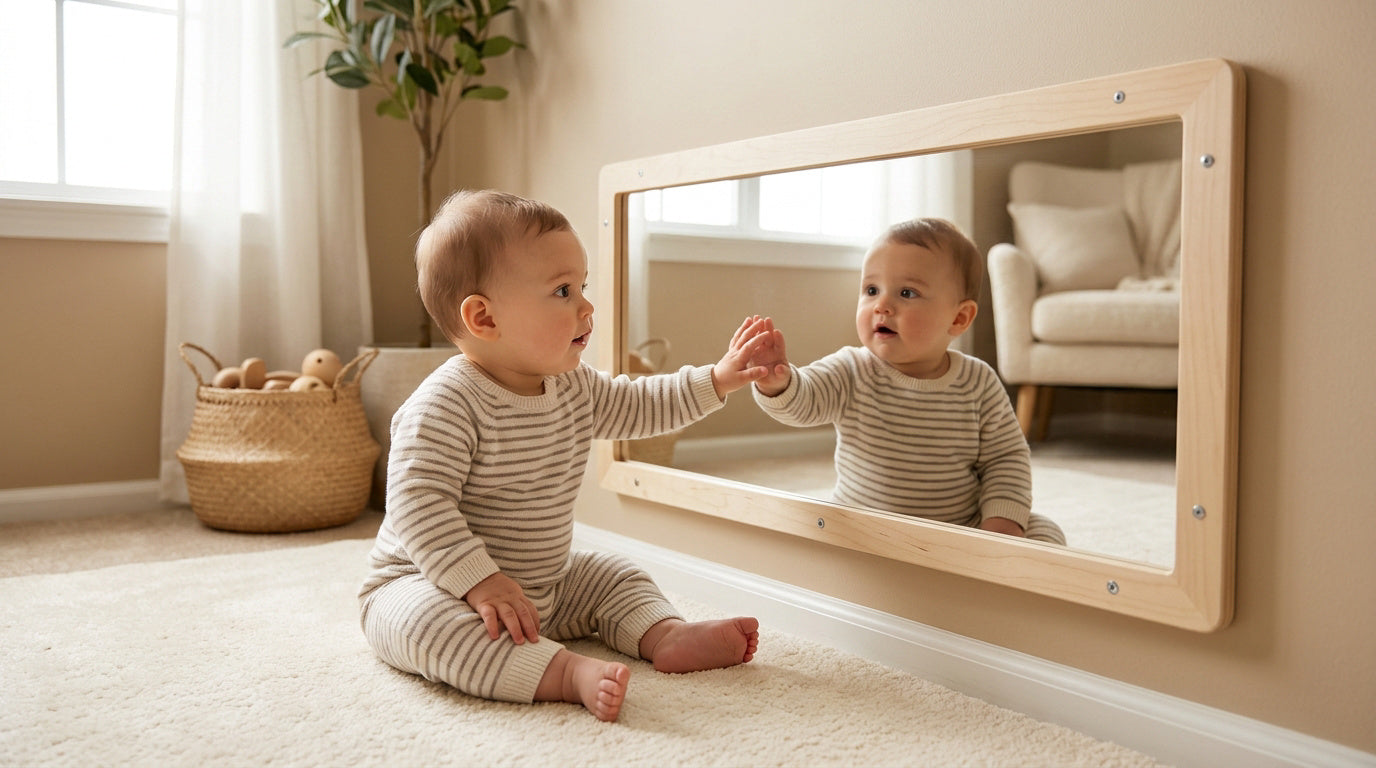
The shatterproof acrylic Montessori mirror fosters self-awareness and gross motor skills from 2 months of age. Installed horizontally on the floor, it allows the infant to observe their own movements, thus facilitating the essential hand-eye coordination.
Observing their reflection is a foundational step for your child's visual development.
Supporting gross motor skills and visual acuity
Your infant watches their own reflection to adjust their natural movements. This mirrored image becomes immediate visual feedback. They rectify their movements in real time.
Fixing their own reflection actively exercises the eyes. This process strengthens hand-eye coordination. Visual acuity progresses fluidly as a result.
Position this accessory near a Montessori baby play mat. This setup creates a secure space for free exploration.
Encouraging recognition of reflection and identity
The baby moves from curiosity to understanding the self. At first, they believe they see a peer. Quickly, they realize that this body is their own.
A psychological transition where the child moves from perceiving a peer to recognizing their physical identity.
This support defines the boundaries of their being. Body image becomes the foundation of their future identity.
The mirror allows the child to discover themselves as a distinct individual, laying the groundwork for their future self-confidence.
The baby car mirror: portable development from Royaume Montessori
Development doesn't stop at the nursery walls; it continues during your daily commutes.
Maintaining eye contact to reassure the child
The visual link with the driver is fundamental for the infant. This constant reflection instantly reassures your little passenger. They feel less alone when rear-facing.
You will observe a notable calming effect during your trips. A child who can see their parent cries less often. Traveling becomes a serene experience for everyone.
For this proximity, install a baby car mirror. This accessory transforms every trip into a special moment of connection.

Technical features and safety during travel
Installation on the headrests is disconcertingly simple. The sturdy straps ensure perfect stability. Your mirror remains fixed despite the vehicle's jolts.
Impact resistance is a pillar of road safety. The acrylic material never shatters in the event of an impact. Your peace of mind relies on this technical requirement.
- Adjustable crossed straps.
- Shatterproof acrylic surface.
- 360-degree rotating pivot.
3 criteria for choosing a secure and shatterproof mirror
To guarantee these benefits without danger, it is imperative to adhere to strict manufacturing standards.
Prioritize plexiglass or high-resistance acrylic
Methacrylate outperforms glass for child development. Glass is prohibited because it shatters. Acrylic offers a clear reflection without the risk of breakage.
The absence of sharp edges protects curious hands. No corner should be able to hurt your baby. The finish must be perfectly smooth and safe.
The safety of a Montessori mirror relies above all on its ability to never produce sharp shards, even under a violent impact.
Opt for a rectangular format without protruding frames
A large format offers a complete view of the body. The baby needs to see their feet and head. A horizontal model encourages holistic body perception.
Installing a Montessori mirror to foster self-awareness requires an understated frame. Too many decorations distract the child. The aesthetics should remain minimalist and natural.
| Criterion | Classic Mirror | Montessori Mirror | Why? |
|---|---|---|---|
| Material | Glass | Acrylic | Prevents breakage. |
| Resistance | Fragile | Shatterproof | Impact safety. |
| Frame | Ornamented | Simple | Zero distraction. |
| Position | High wall | Floor | Adapted to baby. |
How to install the mirror and the pull-up bar?
Once the right model is selected, its placement in the "nido" determines its pedagogical effectiveness.
Horizontal positioning at the level of the play mat
Place your mirror along the living area. It should be parallel to the mat. It then becomes an extension of the play area.
Fix it only a few centimeters from the floor. The child must be able to see themselves without lifting their head. This height is adapted for a baby on the floor.

To design a Montessori bedroom, take care of every detail. Clean the surface with a soft cloth. This preserves a clear and stimulating reflection.
Using the grab bar for standing
The pull-up bar helps the child pull themselves up alone. It effectively builds their muscle strength. It is a valuable aid for their development.
Use anchors adapted to your wall type. The bar must support the child's total weight. Test the sturdiness before letting the baby use it.
- Cut a wooden support.
- Attach the acrylic mirror.
- Screw on the cylindrical bar.
- Secure the assembly to the wall.
Installing a Montessori mirror to foster self-awareness is a foundational act. Your child explores their identity safely. Their autonomy is strengthened as a result.
By installing a shatterproof acrylic Montessori baby mirror, you offer your child essential visual feedback for their hand-eye coordination and the construction of their identity. Fix it now at floor level to transform their nido into a secure space for development. Give them this window into themselves to cultivate their autonomy and lasting confidence.
FAQ
From what age can you install a Montessori mirror for your baby?
You can introduce this development tool from the age of 3 months. Under your attentive supervision, it becomes a fascinating support for observation, allowing your child to discover their reflection and begin to build their visual identity with complete serenity.
Which materials should be prioritized to guarantee your child's safety?
For absolute safety, we recommend opting exclusively for shatterproof materials such as plexiglass, acrylic, or methacrylate. Unlike traditional glass, these surfaces do not produce sharp shards in the event of an impact, ensuring total protection for your little explorer.
Why choose a mirror with rounded edges and a neat finish?
Rounded edges are essential to eliminate any risk of cuts or injury during direct interaction. A perfectly smooth finish and clean lines ensure that the sensory experience remains gentle, safe, and perfectly adapted to the curious hands of toddlers.
How to properly fix the Montessori mirror in your baby's bedroom?
A sturdy and stable wall mounting is imperative to prevent any accidental falls. We recommend installing it horizontally, flush with the floor or a few centimeters from the play mat, so that your child can observe themselves effortlessly from their very first movements on the ground.
What is the purpose of a support bar combined with the mirror?
Adding a support bar is a valuable aid for fostering autonomy and gross motor skills. It allows your child to pull themselves up alone, strengthen their muscles, and gain confidence during their first attempts at standing and their first steps.
How should the plexiglass mirror be maintained to keep a clear reflection?
Maintaining your equipment is very simple. Thanks to the properties of acrylic, regular cleaning with a soft cloth and a product suitable for sensitive surfaces is enough to preserve the clarity of the reflection and the durability of the installation for many years.
What dimensions should you choose for an optimal play area?
To provide your child with a full view when they are on all fours, opt for a rectangular format 90 to 120 cm long. If you have more limited space, a square model with sides of 60 to 70 cm will fit harmoniously while perfectly fulfilling its educational role.