
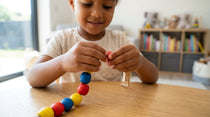
Cognitive & Logical Awakening
Spatial Thinking: The benefits of the Montessori magnetic puzzle
The development of spatial intelligence is a fundamental step in a child's growth. This ability to visualize objects in space and understand their geometric relationships forms the basis for future mathematical and scientific learning. In the Montessori method, sensory materials play a key role in transforming these abstract concepts into concrete manipulations. The magnetic puzzle fits perfectly into this approach by offering a fun and structuring experience.
1. Understanding shapes and volumes
From a very young age, children explore their environment through touch. As we mentioned in our guide to games for 3-year-olds, manipulation is the primary driver of intelligence. The magnetic puzzle allows for an intuitive grasp of geometry: by assembling pieces, the child discovers how simple shapes create complex structures.
The magnetic aspect adds a fascinating dimension: attraction and repulsion. This not only stimulates scientific curiosity but also strengthens the precision of movement, an essential element of fine motor skills.
2. Stimulating problem solving
Faced with a puzzle, the child must develop strategies. They observe, compare, try, and correct their mistakes. This is the very principle of self-correction cherished by Maria Montessori. The magnetic puzzle offers immense creative freedom, allowing the child to move from 2D (plane) to 3D (volume) in an instant, which boosts self-confidence and perseverance.
Discover our magnetic puzzle designed to captivate attention and develop the logic of little builders.
See the Magnetic Puzzle →3. A support for creativity and calm
Unlike noisy games, the puzzle invites calm and deep concentration. It is an activity that soothes while stimulating the mind. In a collection of Montessori toys, it holds a prime spot because it can be used alone or with others, thus fostering both autonomy and collaboration.
FAQ: Your questions about magnetic puzzles
From age 3, under supervision, the child can begin to explore simple shapes. It is between 4 and 6 years old that they will get the most benefit by creating complex structures.
Our puzzles are designed with robust materials and secure magnets. However, it is recommended to regularly check the condition of the pieces.