
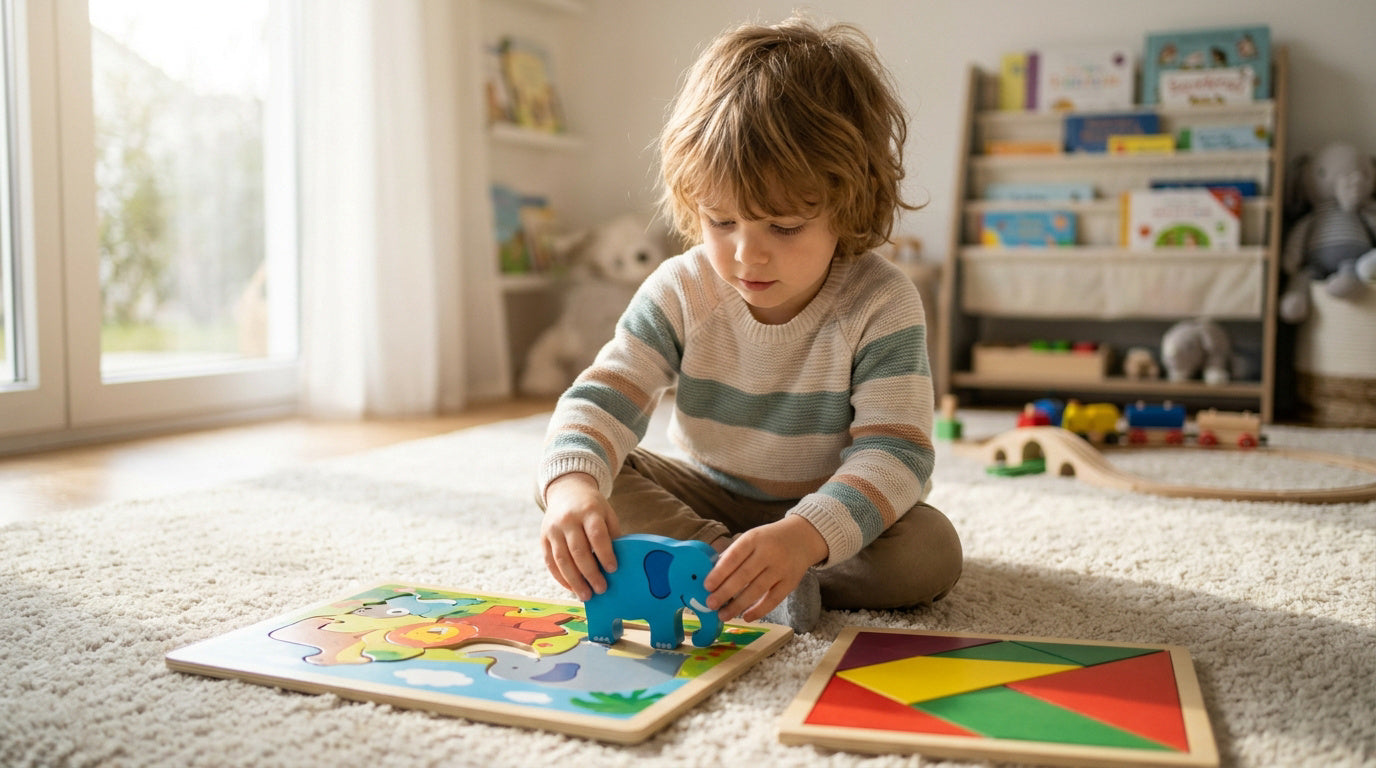
The educational toy market confirms that the puzzle remains a pillar of cognitive development, with models suitable from 18 months to stimulate fine motor skills. However, given the multitude of options, you often risk choosing a model that is too complex, ending up discouraging your child instead of stimulating them.
Learning how to choose a children's puzzle thus becomes a powerful lever for boosting their self-confidence. We will review the selection criteria and materials to prioritize to ensure a harmonious and lasting progression.
- How to choose a children's puzzle: the advantage of personalized wood
- Stimulating coordination with magnetic puzzles and tangrams
- Varying the fun between inlay and 3D reflection
- Technical criteria to validate your final choice
How to choose a children's puzzle: the advantage of personalized wood
An appropriate puzzle has 2 to 4 pieces at age 2, compared to 50 to 100 around age 6. Wood offers superior durability compared to cardboard. Personalization with the first name accelerates letter recognition and autonomy, thus facilitating step-by-step progress.
- 18 months-2 years: 2 to 6 pieces
- 3 years: 12-35 pieces
- 4 years: 36-54 pieces
- 5 years: 50-100 pieces
The relationship between age and number of pieces
The progression grid respects biological rhythm. Montessori puzzles often start with unique shapes before increasing the number of segments. This approach promotes gentle assimilation.
The risk of frustration remains real. A challenge that is too difficult blocks learning. Choose Montessori toys for ages 3, 4, and 5 that are adapted to keep interest constant.
Self-esteem is key. Immediate success boosts the child's confidence.
The impact of personalization on autonomy
The first name has immense pedagogical power. The child manipulates the letters of their own identity. Discover this personalized wooden name puzzle for children to stimulate this awakening.

Emotional involvement multiplies the results. Owning a unique object boosts autonomy. The interest in the activity then becomes natural and lasting.
The personalized puzzle transforms a simple cognitive exercise into a rewarding journey of identity for the young child.
Stimulating coordination with magnetic puzzles and tangrams
But beyond the number of pieces, the very technology of the support, such as magnetism, transforms the precision of movements.
Why do magnetic pieces support gripping?
The magnet stabilizes every movement. It compensates for the natural tremors of small fingers. It is a precious ally for fine motor skills.
This travel format proves highly effective. The pieces remain fixed in a car or train. This magnetic wooden Montessori tangram ensures total practicality anywhere.
Use magnetic puzzles in the car or train to avoid losing pieces and reduce frustration linked to movement.
Here are the major assets:
- Optimal stability of the pieces.
- Immediate reduction of frustration.
- Greatly facilitated nomadic use.

The tangram to explore plane geometry
Manipulating space becomes concrete. Assembling triangles and squares forges a logical mind. Discover this Montessori tangram - geometric shape puzzle to get started.
The child then moves on to free creation. They invent their own silhouettes without any imposed model. This is a major step in overall cognitive development.
In fact, this activity is unique:
The tangram is the perfect bridge between mathematical rigor and the child's unbridled imagination.
Varying the fun between inlay and 3D reflection
However, plane geometry is only a start, as exploring volume offers even more intense concentration challenges.
Sensory awakening through inlayable shapes
The use of pegs is fundamental for little ones. These knobs engage the thumb-index pincer grasp. Offering an inlayable puzzle promotes this early dexterity.
Pegs are crucial for exercising the thumb-index pincer grasp before moving on to drawing.
From 18 months old, the child associates the object with its outline. This is the beginning of visual logic. They thus identify silhouettes with precision.

- Simple geometric shapes, animals, vehicles, sound puzzles.
The wooden tetris challenge for concentration
3D requires anticipating volume and balance. Using Montessori brain-building blocks is a real challenge. This intensely stimulates the mind.
This developmental game follows the child over several years. Its multiple combinations engage concentration to the maximum. Interest remains intact over time.
Successfully completing a complex assembly provides great satisfaction. Wood offers a rewarding and lasting tactile experience.
Technical criteria to validate your final choice
So, once the type of game is identified, how do you ensure the object will last in the toy box over time?
Analyze the quality of cuts and finishes
First check the sharpness of the edges. The thickness of the wood guarantees real solidity in the event of drops. Perfectly smooth pieces avoid any risk of splinters for your child.
Then compare materials based on use. High-density cardboard offers practical lightness. However, natural wood remains unbeatable for longevity and resistance.
| Material | Durability | Weight | Ideal for |
|---|---|---|---|
| Wood | 5/5 | Heavy | Daily use |
| Cardboard | 3/5 | Light | Occasional use |
| Plastic | 4/5 | Medium | Bath time |
Our tips for cleaning and storing pieces
Adopt gentle cleaning methods. A simple dry or damp cloth is often sufficient. Above all, avoid soaking the wood so as not to permanently warp it.
Use small zipper bags or dedicated boxes for storage. This rigorous organization prevents losing a piece. This preserves the integrity of the activity in the long term.
Tidying up together is a precious educational moment. It is a key step for autonomy. Discover also the best wooden toys for baby's awakening to complete their collection.
Offer your child a custom-made awakening by adapting the number of pieces to their age and favoring the nobility of wood. Order your personalized puzzle now to transform this learning process into a stimulating quest for identity. A precise choice today guarantees their autonomy and confidence tomorrow.
FAQ
What is the ideal number of pieces based on my child's age?
To ensure immediate enjoyment without frustration, we recommend following a progression adapted to your little one's development. Between 18 months and 2 years old, opt for peg puzzles with 2 to 6 pieces. Around age 3, you can move on to models with 12 to 35 pieces, then increase gradually: 50 to 100 pieces for a 5-year-old, and up to 350 pieces by age 6.
The goal is to offer a stimulating challenge that strengthens self-esteem. A puzzle that is too complex might discourage your child, while one that is too simple could quickly bore them. Observe their comfort level to adjust the degree of difficulty.
Why choose a wooden puzzle over a cardboard one?
Wood is the premier material for educational toys thanks to its sturdiness and exceptional durability. Unlike cardboard, wooden pieces offer a thickness that facilitates handling and fine motor skills, perfectly resisting the repeated use by younger children. It is a lasting investment that can be passed down to siblings over several years.
From a sensory perspective, natural wood provides a gratifying and warm tactile experience. For parents concerned about safety, our puzzles feature rounded edges and careful finishing, ensuring a calm and secure play experience in your child's bedroom.
What are the educational benefits of a personalized name puzzle?
Personalization transforms a simple cognitive exercise into an enriching quest for identity. By handling the letters of their own name, your child develops their visual perception and becomes familiar with the alphabet in a playful way. It is a powerful tool to boost autonomy and emotional connection to the object.
Beyond the educational aspect, these wooden puzzles become beautiful decorative items. They stimulate color recognition and hand-eye coordination, while giving your child the pride of owning a unique toy, designed specifically for them.
How do magnetic puzzles make traveling easier?
Magnetic puzzles are your best allies for keeping your child occupied during car or train trips. Thanks to their adhesive surface, the pieces do not fall and stay perfectly in place, thus reducing the frustration associated with losing parts. It is the ultimate portable solution for maintaining focus wherever you go.
Many pocket formats, such as tangrams or magnetic logic games, offer progressive challenges. They allow for stimulating critical thinking and fine motor skills in a confined space, while offering unmatched storage convenience for active parents.
What does tangram practice contribute to logical development?
The tangram is an extraordinary tool for exploring plane geometry from a very young age. By assembling these seven geometric pieces, your child learns to visualize space and understand how simple shapes create complex figures. It is a perfect introduction to the concepts of symmetry and rotation.
This activity encourages patience and problem-solving. Whether by following patterns or creating original silhouettes, your child develops their imagination while structuring their logical thinking. It is the ideal bridge between mathematical rigor and unbridled creativity.